
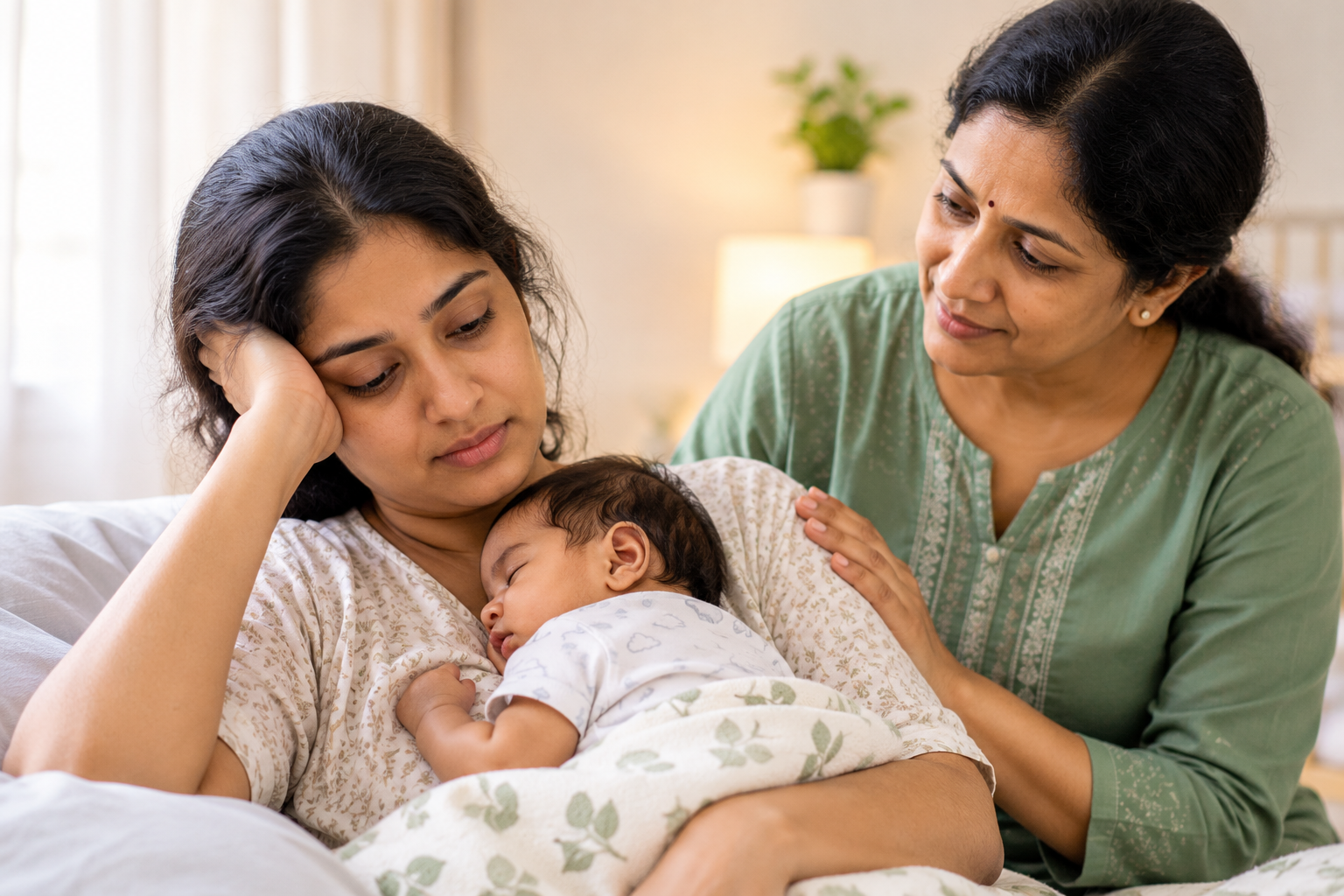
A new baby is supposed to be a joyful time. For many mothers it is, at least some of the time. But for a significant number, the weeks and months after birth bring something very different: a heavy sadness that won’t lift, overwhelming anxiety, exhaustion that sleep doesn’t touch, and a painful sense of failing at the thing everyone says should come naturally.
If that sounds like you, or someone you love, please know this first: postpartum depression is a common, recognised medical condition, it is not a sign that you are a bad mother, and it is treatable. This guide explains what it is, how it differs from the “baby blues” and from the rarer and more serious postpartum psychosis, what causes it, how it is treated, and how families can help. It is general information, not a diagnosis.
In short
- Baby blues are common mood swings in the first days after birth and usually ease within about two weeks. Postpartum depression lasts longer, is more intense, and affects daily life.
- Postpartum psychosis is rare but is a medical emergency: hallucinations, delusions, severe confusion or thoughts of harming yourself or the baby need immediate help (call 112).
- Symptoms can include persistent low mood, anxiety, irritability, loss of interest, exhaustion, difficulty bonding, and hopelessness. They can start any time in the first year.
- It has many causes, including hormonal change, sleep loss, history of depression, stress and lack of support. It is not caused by anything you did or didn’t do.
- Treatment works: talking therapy, sometimes medication (which can often be compatible with breastfeeding, decided with a doctor), and practical support. Fathers and partners can also be affected.
- If you feel you could harm yourself or your baby, tell someone now.
Baby blues, postpartum depression and postpartum psychosis
These three are often confused, and the differences matter.
| Baby blues | Postpartum depression | Postpartum psychosis | |
|---|---|---|---|
| How common | Very common | Common | Rare |
| When it starts | Within the first few days after birth | Often in the first weeks or months, and can begin later in the first year | Usually within the first days or weeks |
| How long it lasts | Usually eases within about two weeks | Lasts longer than two weeks and may continue for months without treatment | Needs urgent treatment |
| What it feels like | Tearfulness, mood swings, irritability, feeling overwhelmed, anxious | Persistent low mood, anxiety, loss of interest, exhaustion, guilt, hopelessness, difficulty bonding | Confusion, hallucinations, delusions, extreme agitation or mood swings, very little need for sleep |
| Effect on daily life | Mild, brief | Significant | Severe, with risk to mother and baby |
| What to do | Rest, support, reassurance | Seek assessment and treatment | Emergency. Call 112. |
Many mothers feel unsure which of these they are experiencing. You don’t have to work it out yourself: describe how you feel to a doctor, midwife or health worker.
What is postpartum depression?
Postpartum depression (PPD) is a form of depression that begins after childbirth. The DSM-5-TR describes depression “with peripartum onset” when it begins during pregnancy or in the weeks after delivery, and many clinicians and guidelines recognise postnatal depression as beginning at any point in the first year. You may also hear perinatal depression, an umbrella term for depression during pregnancy and after birth.
It is more than being tired or emotional. It is a persistent change in mood, thinking and functioning that makes it hard to enjoy your baby, look after yourself, or get through the day.
Symptoms
Symptoms vary, and not every mother has all of them. Some mothers cry a lot, while others feel numb, angry or simply “not there”. Look for a cluster that lasts more than two weeks and affects daily life.
| Area | What it can look like |
|---|---|
| Mood | Persistent sadness, emptiness or hopelessness, tearfulness, irritability, anger, feeling overwhelmed or numb |
| Interest and enjoyment | Losing interest in things you used to enjoy, including the baby, or feeling nothing at all |
| Thoughts | Constant guilt or self-criticism, feeling like a failure or a bad mother, difficulty concentrating or deciding, thinking the baby would be better off without you |
| Anxiety | Constant worry about the baby’s health or safety, racing thoughts, panic, checking repeatedly, fear of being alone with the baby |
| Body | Exhaustion that isn’t relieved by rest, changes in appetite, difficulty sleeping even when the baby sleeps, headaches, aches and pains |
| Bonding and care | Difficulty feeling close to the baby, feeling detached, or doubting your ability to care for them |
| Behaviour | Withdrawing from family and friends, avoiding visitors, neglecting your own needs |
| Thoughts of harm | Thoughts of dying, of harming yourself, or of harming your baby. These need urgent help. |
Anxiety is very common alongside postpartum depression, and some mothers have mostly anxiety, with obsessive thoughts. Our anxiety disorder page explains how anxiety conditions are assessed.
Intrusive thoughts about the baby
Many new mothers have unwanted, frightening thoughts or images about something bad happening to the baby, such as dropping them or someone harming them. These are common, especially with anxiety or obsessive-compulsive symptoms, and they are different from wanting to cause harm. They are distressing precisely because you love your baby. They don’t mean you will act on them.
Still, please tell a doctor about them, because they can be treated, and keeping them secret tends to make them worse. If you feel you might harm yourself or your baby, or you hear voices or believe things that aren’t real, get help immediately.
Postpartum psychosis: an emergency
Postpartum psychosis is rare but serious. It usually comes on suddenly, often within the first days or weeks after birth, and is more common in women with bipolar disorder or a past episode of psychosis, though it can happen without any history. Signs include:
- Seeing or hearing things that aren’t there
- Strange or fixed beliefs, such as thinking the baby is in danger or has special powers
- Severe confusion or disorientation
- Extreme agitation, restlessness or rapidly shifting mood
- Not sleeping and not feeling tired
- Behaving in an out-of-character way
- Thoughts of harming yourself or the baby
This needs urgent medical care. Call 112 or go to the nearest emergency department straight away, and don’t leave the mother alone with the baby. With prompt treatment, most women recover.
What causes postpartum depression?
There is no single cause, and it is not your fault. Contributing factors include:
- Hormonal changes. Oestrogen and progesterone drop sharply after delivery, and some women appear more sensitive to this, though hormones alone don’t explain it.
- Sleep loss and exhaustion, which affect mood and resilience.
- A history of depression or anxiety, or of depression in pregnancy or after an earlier birth
- Family history of mood disorders
- Stressful life events, such as bereavement, financial strain or moving
- Lack of support, or relationship difficulties
- A difficult pregnancy or birth, a traumatic birth, or a baby with health problems
- Pregnancy loss or past trauma
- Thyroid problems, which can mimic or contribute to depression
- Isolation and heavy responsibility, for example caring for a new baby alone
- Alcohol or substance use
Having risk factors doesn’t mean a mother will become depressed, and mothers with no obvious risk factors can be affected too.
Postpartum depression in India
Research in India has identified several things that can increase the risk, alongside the general factors above. A study of mothers in Goa by Patel and colleagues (2002), for example, linked postnatal depression with factors such as poverty, a mother’s relationship with her partner and family, and having a baby of a gender the family didn’t prefer. Findings vary between communities and studies, but these themes matter:
- Family expectations and pressure, including pressure about the baby’s gender or about how a new mother should behave
- Strained relationships with a partner or in-laws, or feeling unsupported
- Returning to a parental home, and the loss of independence or disruption that may bring
- Stigma. Depression may be dismissed as weakness, tiredness, “something all mothers go through” or attributed to other causes, so help is often delayed
- Practical strain: money, housework, lack of rest
Family can also be the greatest source of protection. A supportive partner and family that share the load make a real difference.
Fathers and partners can be affected too
Depression after a baby’s birth isn’t limited to mothers. Research shows a meaningful number of fathers and partners also experience low mood and anxiety. They may show it as irritability, withdrawal, working more or drinking more. It deserves attention, and a partner’s depression can in turn affect the mother and baby.
How is it diagnosed?
There is no blood test for postpartum depression. A doctor, psychiatrist or trained health professional will:
- Talk with you about your mood, thoughts, sleep, energy, anxiety, bonding, support and any thoughts of harm
- Use a questionnaire, such as the Edinburgh Postnatal Depression Scale (EPDS), which screens for depression after childbirth. It is a screening tool and does not diagnose by itself.
- Check your physical health, including for thyroid problems, anaemia and other conditions that can look like depression
- Ask about your history, including earlier depression, anxiety, bipolar disorder or psychosis
- Assess safety, including any thoughts of harming yourself or the baby
Be as honest as you can. Nothing you say is too much, and professionals are there to help, not to judge.
Treatment: what helps
Postpartum depression responds well to treatment, and it’s usually most effective when it begins early. A plan depends on how severe the symptoms are, your preferences, whether you are breastfeeding, and what support you have.
1. Support and practical help.
This is part of treatment, not an extra. Sharing night feeds, help with housework and meals, time to sleep and time for yourself all matter.
2. Talking therapy.
- Cognitive behavioural therapy (CBT) helps with the thoughts and behaviours that keep depression and anxiety going. See our page on cognitive behavioural therapy and our Behavioural Therapy page.
- Interpersonal therapy focuses on relationships and role changes, which is why it is often used after childbirth.
- Group and peer support can also help.
Guidelines, such as those from NICE and the WHO, recommend psychological therapies for mild to moderate postnatal depression.
3. Medication.
For moderate to severe depression, a doctor may recommend antidepressant-type medicine, alone or alongside therapy. If you are breastfeeding, tell your doctor. Many mothers can continue to breastfeed on certain medicines, but the choice depends on the medicine, your baby and your situation. Never start, change or stop a medicine on your own. Our guide to how to tackle mental health issues explains what to expect from a psychiatric assessment.
4. Specialist and hospital care.
Severe depression, thoughts of harming yourself or the baby, or psychosis need specialist care, which may include hospital treatment. Some places have mother-and-baby units, where a mother can be treated while staying with her baby, though these are not widely available everywhere.
5. Treatment of related problems.
These include anxiety, trauma after a difficult birth, and alcohol or substance use. Our guides to trauma therapy and dual diagnosis explain why treating both together matters.
What you can do to help yourself
These help alongside professional care. They don’t replace it.
- Protect sleep. Sleep whenever the baby sleeps if you can, and ask someone to take a night feed. Broken sleep makes everything harder.
- Accept help, and ask for specific things: “Could you cook dinner tonight?” or “Could you hold the baby while I sleep?”
- Eat regularly and drink water.
- Get daylight and gentle movement, such as a short walk with the pram. See our guide to exercise for mental health.
- Lower your standards. A fed, safe baby and a rested mother are the goal. A spotless house is not.
- Talk to someone you trust, and tell them honestly how you feel.
- Limit comparison. Social media shows other mothers’ best moments. Our guide to how to overcome social media addiction offers a step-by-step plan.
- Avoid alcohol, which worsens mood and sleep, and can be risky around a baby.
- Be kind to yourself. You are doing a very hard thing.
More ideas are in our guides to stress management techniques and how to stop overthinking.
If you are supporting a new mother
- Listen without judging. Say “It sounds really hard, and it isn’t your fault”, not “You should be grateful” or “Every mother goes through this”.
- Take practical load off her: night feeds, meals, housework, visitors, appointments.
- Protect her sleep.
- Encourage her to talk to a doctor, and offer to go with her and look after the baby during the appointment.
- Don’t take it personally if she seems distant or irritable.
- Never dismiss it as tiredness, attention-seeking or weakness.
- Watch for danger signs: talk of dying or harming herself or the baby, confusion, strange beliefs or not sleeping at all. These need urgent help.
- Look after yourself, since supporting someone with depression is demanding, and partners can become depressed too.
Our guides to how to deal with a person with anxiety and depression and how to support a partner through depression without losing yourself explain what helps and what doesn’t.
Why treating it matters, for mother and baby
Untreated postpartum depression can affect a mother’s health and, in research, has been associated with difficulties in bonding, feeding, sleep and later child development, though these links are associations, and many children do well, especially when mothers get help. The message from the research is practical: treating the mother’s depression is one of the best things you can do for your baby too. Seeking help is an act of care.
Myths and facts
| Myth | Fact |
|---|---|
| “Having a baby should be the happiest time. Feeling sad means something is wrong with you.” | Many mothers feel low, anxious or numb. It is a medical condition, not a failure. |
| “It’s just the baby blues, it’ll pass.” | Baby blues pass within about two weeks. Longer or more intense symptoms need assessment. |
| “Only mothers get it.” | Fathers and partners can be affected too. |
| “If I tell someone, they’ll take my baby.” | Doctors want to help you and your baby stay well. Seeking treatment usually protects the family. |
| “Antidepressants aren’t safe if I’m breastfeeding.” | Many mothers can continue breastfeeding on certain medicines. Discuss the options with your doctor. |
| “Good mothers don’t get depressed.” | Depression is not a reflection of how much you love your baby. |
| “I just need to try harder.” | Depression is not a lack of effort. Effective treatment and support help. |
| “Thoughts about harm coming to the baby mean I’m dangerous.” | Unwanted, frightening thoughts are common and distressing, and usually don’t mean you will act. Tell a doctor so you can get help. |
When to get help urgently
Get emergency help straight away if you or someone else:
- Is thinking about suicide or about harming themselves
- Has thoughts of harming the baby, or feels unable to keep the baby safe
- Is seeing or hearing things that aren’t there, or has strange, fixed beliefs
- Is severely confused, extremely agitated, or hasn’t slept for days
- Is unable to look after themselves or the baby
Call 112 or go to the nearest emergency department. In India you can also reach:
- Tele-MANAS (14416): free, confidential mental health support
- Women Helpline (181): support for women facing violence or abuse
- Child helpline (1098): if a child’s safety is at risk
If a mother is in danger, don’t leave her alone, and don’t leave her alone with the baby.
When to see a doctor
Speak to a doctor, psychiatrist, midwife or health worker if:
- Low mood, anxiety or numbness lasts more than two weeks
- You can’t sleep when the baby sleeps, or you feel constantly exhausted and hopeless
- You are struggling to care for yourself or the baby, or to bond
- You feel panicky, or have constant intrusive or frightening thoughts
- You are drinking or using substances to cope
- You have had depression, anxiety or bipolar disorder before
- Family or friends are worried about you
You can raise it at a postnatal check, a vaccination visit for the baby, or any time.
How Thamarai can help
At Thamarai Healing Center in Pollachi, care for depression and anxiety begins with a comprehensive medical and psychiatric assessment, so that the full picture is understood, including physical health, sleep, mood, anxiety and any substance use. Our multidisciplinary team includes a consultant psychiatrist and a consultant psychologist, and our services list depression among the conditions we treat. Care combines evidence-based therapies such as CBT with a calm, private setting, and our Signature Women’s Program offers dedicated, supportive care for women. Severe postpartum illness, or psychosis, may need hospital-based or specialist perinatal care, and a confidential conversation can help you work out the right level of care. You can read more about our mental illness treatment care.
If you or someone you love is struggling after a birth, a confidential conversation is a good place to start. Speak to our team confidentially →
Frequently asked questions
What is postpartum depression?
A form of depression that begins after childbirth, with persistent low mood, anxiety, exhaustion, loss of interest, guilt and difficulty coping or bonding, lasting more than two weeks and affecting daily life.
What is the difference between baby blues and postpartum depression?
Baby blues are common mood swings in the first few days after birth and usually ease within about two weeks. Postpartum depression lasts longer, is more intense, and interferes with daily life, and it needs assessment and treatment.
When does postpartum depression start?
Often in the first weeks or months after birth, though it can begin at any time in the first year, and sometimes starts during pregnancy.
What causes postpartum depression?
Several things together: hormonal changes, sleep loss, a history of depression or anxiety, stress, lack of support, a difficult birth, and other factors. It is not caused by anything you did or didn’t do.
How long does postpartum depression last?
It varies. With treatment, many women improve within weeks to months. Without treatment, it can last much longer.
Can postpartum depression be treated?
Yes. Talking therapy, sometimes medication, practical support and specialist care when needed help most women recover.
Is it safe to take antidepressants while breastfeeding?
Many mothers can breastfeed on certain medicines, but the right choice depends on the medicine, your baby and your situation. Discuss it with your doctor, and don’t start or stop medicine on your own.
Can fathers get postpartum depression?
Yes. Fathers and partners can experience depression and anxiety around a baby’s birth, and they should seek help too.
What is postpartum psychosis?
A rare, serious condition with hallucinations, delusions, severe confusion or extreme agitation, usually starting within days or weeks of birth. It is an emergency. Call 112 or go to the nearest emergency department.
This article is for general information and isn’t a substitute for professional medical advice, diagnosis or treatment. If you or someone else is in danger, call 112.
Sources
- American Psychiatric Association. Diagnostic and Statistical Manual of Mental Disorders, Fifth Edition, Text Revision (DSM-5-TR). 2022 (depressive disorders; specifier “with peripartum onset”).
- NICE. Antenatal and postnatal mental health: clinical management and service guidance (CG192).
- World Health Organization. Guide for integration of perinatal mental health in maternal and child health services. 2022.
- Cox JL, Holden JM, Sagovsky R. Detection of postnatal depression: development of the 10-item Edinburgh Postnatal Depression Scale. British Journal of Psychiatry, 1987.
- Stewart DE, Vigod S. Postpartum depression. New England Journal of Medicine, 2016.
- Patel V, Rodrigues M, DeSouza N. Gender, poverty, and postnatal depression: a study of mothers in Goa, India. American Journal of Psychiatry, 2002.
- Gelaye B, Rondon MB, Araya R, Williams MA. Epidemiology of maternal depression, risk factors, and child outcomes in low-income and middle-income countries. Lancet Psychiatry, 2016.
- Jones I, Chandra PS, Dazzan P, Howard LM. Bipolar disorder, affective psychosis, and schizophrenia in pregnancy and the post-partum period. The Lancet, 2014.