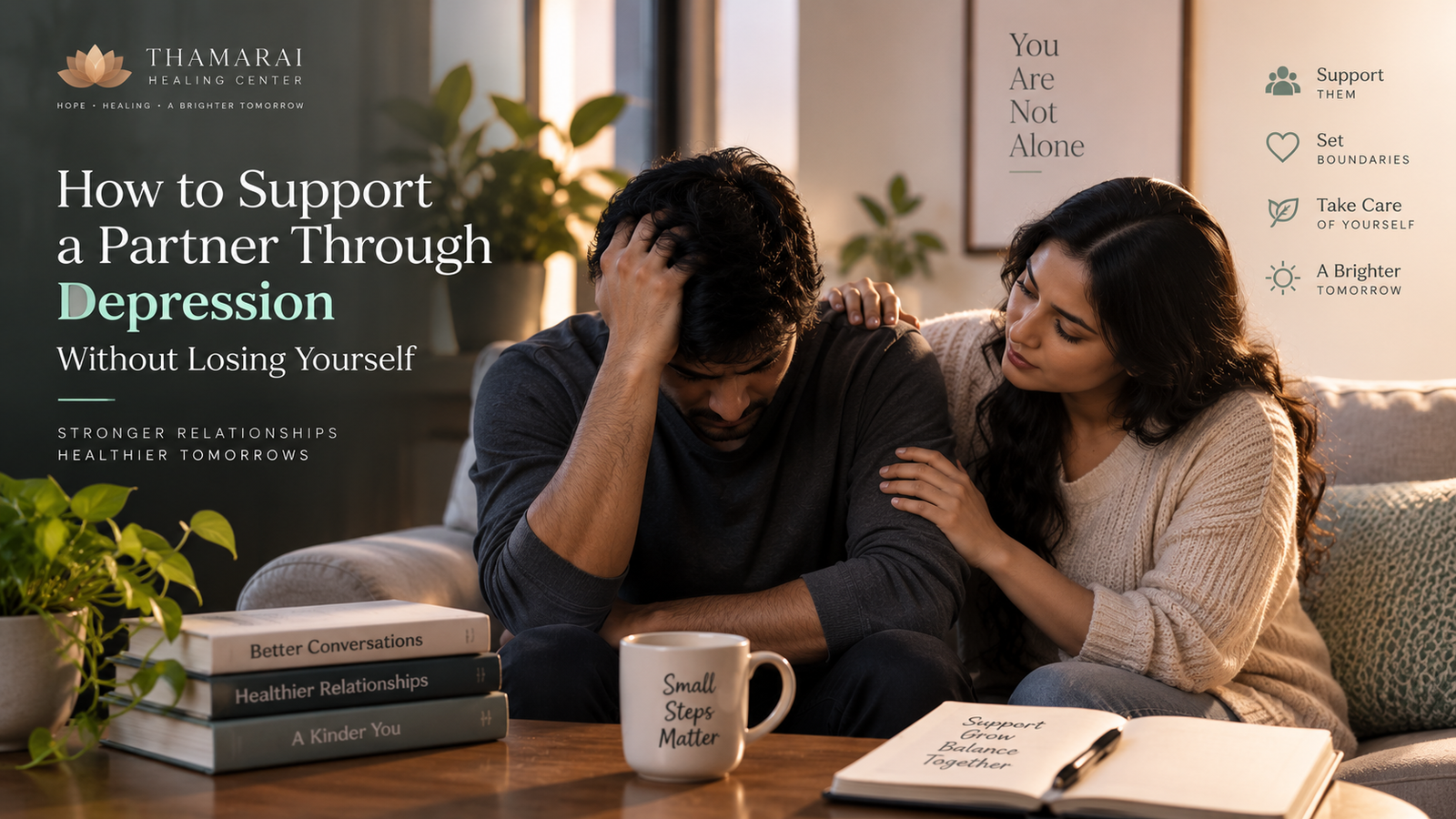
Introduction — Supporting Someone Doesn’t Mean Losing Yourself
Watching someone you love struggle with depression can leave you feeling helpless in a very particular way. You want to help, but you’re not always sure how. You want to be patient, but some days patience runs thin. And somewhere in the middle of it, it’s easy to lose track of your own needs entirely.
Depression can show up differently in every relationship. You might notice withdrawal, low motivation, or irritability. Communication may shift. Interest in activities you once shared may fade. Sleep and appetite can change, and even small everyday responsibilities can start to feel harder for your partner to manage.
Not every couple experiences all of these changes, and not every change means the same thing. But when several of them appear together and persist, it’s natural for both people in the relationship to feel the strain.
If you’re looking for practical guidance on how to support a partner through depression, the most important thing to understand early is this: supporting your partner does not mean becoming their therapist, their caregiver, or their only source of support. You can care deeply about someone and still protect your own wellbeing at the same time. In fact, doing both is usually what makes support sustainable in the first place.
What Is Depression and How Can It Affect a Relationship?
Depression is a recognised mental health condition, not simply low mood or a bad week. According to the World Health Organization (WHO) and the American Psychiatric Association, common symptoms include persistent low mood, loss of interest or pleasure in activities once enjoyed, fatigue, difficulty concentrating, feelings of worthlessness or guilt, changes in sleep and appetite, social withdrawal, and, in some cases, feelings of hopelessness.
These symptoms don’t stay contained to one person. In a relationship, they can show up as:
- Less frequent or shorter conversations
- Changes in affection or physical closeness
- Difficulty joining shared social activities
- Reduced motivation for chores, plans, or responsibilities
- Shifts in intimacy
It’s tempting to read every one of these changes as a direct message about the relationship itself. Try to resist that instinct. Reduced affection or a quieter evening doesn’t always mean what it seems to mean on the surface — and assuming you already know is usually less helpful than simply asking. Open, honest communication tends to tell you far more than guesswork ever will.
1. Ask, Don’t Assume
It’s rarely useful to open with something like “What’s wrong with you?” — even when it comes from real concern, it can land as criticism.
A gentler entry point works better: “I’ve noticed you’ve seemed withdrawn lately. How have you been feeling?”
From there, a few honest questions can do a lot of work:
- “Do you want me to listen, or help you think through solutions?”
- “What would feel supportive right now?”
- “Would you like help finding professional support?”
- “Would you rather have some space, or some company?”
The goal isn’t to diagnose or direct — it’s to understand. Support works best as a collaboration, not something done to someone.
2. Listen Without Trying to Fix Everything
When someone you love is in pain, the instinct to fix it is completely natural. But depression usually isn’t something that responds to advice, however well-intentioned.
Try to avoid phrases like:
- “Just think positively.”
- “You have so much to be grateful for.”
- “Everyone feels like this sometimes.”
- “You just need to get out more.”
These can unintentionally suggest that your partner simply isn’t trying hard enough — which is rarely true, and rarely helpful to hear.
What tends to help more is simpler: listening fully, validating what they’re feeling, staying patient, and asking what they actually need rather than assuming. For example, if your partner says they feel like a burden, you don’t need to argue them out of the feeling in the moment. Something like “That sounds really heavy to carry — I’m glad you told me” acknowledges the feeling without agreeing that it’s true.
3. Encourage Professional Help Without Becoming Their Therapist
Depression often benefits from professional assessment — this might involve a psychologist, psychiatrist, or another qualified mental health professional, depending on the person’s needs.
You can genuinely help with the practical side of this:
- Researching appropriate professional support
- Helping schedule an appointment
- Offering transport
- Accompanying them, if they’d like company
- Supporting daily routines that make seeking help more manageable
What matters just as much is knowing where your role ends. Their treatment belongs to them. You can support the process, but diagnosing your partner or trying to act as their therapist isn’t something you’re equipped — or meant — to do, and attempting it usually puts strain on both of you.
4. Understand the Difference Between Support and Responsibility
This distinction is one of the most important things to get right.
| Your Role | Not Your Responsibility |
|---|---|
| Listen | Cure their depression |
| Encourage appropriate professional help | Diagnose your partner |
| Offer practical support | Monitor their every emotion |
| Communicate honestly | Solve every problem for them |
| Respect boundaries | Manage their entire treatment |
| Encourage healthy routines | Sacrifice your entire life |
Keeping this table in mind — even informally — can prevent a slow drift into over-responsibility, which tends to exhaust the supporting partner without actually helping the other person heal.
5. Keep Your Own Life Going
This is the heart of “without losing yourself.”
It’s common, almost without noticing, to quietly deprioritise your friends, family, hobbies, work, exercise, sleep, and personal interests while supporting someone through depression. Over time, this rarely helps your partner — and it steadily costs you.
Supporting your partner does not require you to stop being a person outside the relationship. Keeping your routines, your friendships, and your own sense of identity intact isn’t a distraction from supporting them. It’s what makes that support possible to sustain.
6. Set Healthy Boundaries
Boundaries aren’t punishment, and they aren’t abandonment. They’re what allows care to continue without becoming depletion.
Some examples of how this can sound in practice:
Communication: “I want to talk about this, but I can’t continue the conversation if we’re shouting at each other.”
Personal time: “I care about you, and I’m going to spend some time with my friends tonight.”
Responsibility: “I can help you find support, but I can’t manage your treatment for you.”
Respect: “Depression can affect emotions and behaviour, but it doesn’t mean either of us has to accept abuse.”
That last point deserves to be stated plainly: depression is a real and serious condition, but it does not excuse emotional, physical, sexual, or any other form of abuse. If a relationship involves abusive behaviour, that is a separate and serious concern that deserves its own support, regardless of what else may be going on.
7. Don’t Take Every Change Personally
Depression can affect communication, affection, sexual interest, social participation, and emotional availability — and it’s easy to interpret these shifts as being about you specifically.
Sometimes they are related to the relationship. Often, they’re not. The honest answer is that you usually can’t tell just by observing from the outside. Changes in behaviour may be connected to depression, but the safest approach is still to communicate rather than assume — for your own peace of mind as much as anything else.
8. Maintain Small Moments of Connection
Not every interaction needs to be a deep conversation about how your partner is feeling. Low-pressure, ordinary moments matter too:
- A short walk together
- Watching a familiar show
- Eating a meal together
- Sitting quietly in the same room
- Making tea
- Listening to music
- Cooking together
These moments keep the relationship from becoming entirely defined by depression. And they don’t need to come with pressure to “cheer up” your partner — simple companionship is enough on its own.
9. Know When to Give Space — and When to Stay Present
People experiencing depression don’t all want the same thing. Some want company. Others want quiet. Some want practical help, others conversation, physical affection, or time completely alone.
Rather than guessing, it’s usually more effective to ask directly: “Would you like me to sit with you, listen, help with something practical, or give you some space?” Letting your partner name what they need, when they’re able to, respects their autonomy and takes the guesswork off your shoulders.
10. Recognise Signs That You Are Burning Out
Supporting someone through depression over an extended period can take a real toll. Watch for signs in yourself such as constant exhaustion, irritability, anxiety, resentment, a sense of being responsible for every problem, neglecting your own needs, withdrawing socially, sleep difficulties, feeling trapped, or losing interest in your own life.
These are signs of emotional exhaustion and stress that deserve attention — your wellbeing matters here too, not only as a means of sustaining your support for your partner, but in its own right.
11. Get Support for Yourself
Seeking support for yourself is not a sign that you’re abandoning your partner — it’s part of what allows you to stay present for them sustainably.
That support might come from trusted friends or family, individual counselling, couples counselling where appropriate, support groups for partners of people with depression, maintaining your own healthcare, or simply taking intentional breaks when you need them. None of these are indulgent. They’re part of a sustainable approach to caring for someone else.
12. What If Your Partner Refuses Help?
This is one of the harder situations partners face. You can express your concern honestly, encourage professional help, offer practical assistance, share reputable resources, set your own boundaries, and protect your own wellbeing throughout.
What you generally cannot do is make another adult participate in treatment simply because you believe they need it. That limitation can feel frustrating, even frightening, but it’s also an important boundary to accept — your responsibility is to offer support consistently, not to control an outcome that isn’t within your control. If you’re concerned about immediate safety, that changes the picture, which brings us to the next section.
13. What If Your Partner Talks About Suicide or Self-Harm?
If you believe your partner is in immediate danger, seek emergency help now.
Any mention of wanting to die, suicide, self-harm, feeling there’s no reason to live, or being in immediate danger should always be taken seriously — never dismissed as attention-seeking or exaggeration.
If you’re in this situation:
- Stay with the person if it’s safe for you to do so
- Encourage urgent professional or emergency help
- Contact local emergency services, or an appropriate crisis line
- Involve a trusted person when appropriate
- Do not promise to keep imminent risk a secret, even if asked to
In India, the national emergency number 112 connects you to police, fire, and ambulance services. The Government of India’s Tele-MANAS mental health helpline (14416, or 1800-891-4416) offers free, confidential, 24/7 support in English and regional languages, and can connect callers to a mental health professional when needed.
This is not a moment for hesitation or for trying to manage the situation entirely on your own.
14. When Couples Counselling May Help
Relationship-focused professional support can be genuinely useful when communication has broken down, resentment is building, both of you feel misunderstood, depression is affecting intimacy, conflict keeps recurring, or you feel consistently overwhelmed.
Couples counselling is not a substitute for individual treatment of depression — it works alongside it, addressing the relational patterns that depression can strain, while your partner’s individual care addresses the condition itself.
15. A Simple Weekly Support Approach
This isn’t a medical treatment plan — just a general framework some couples find useful to adapt to their own circumstances.
Daily: One small moment of connection. Respect for personal space. Gentle encouragement of ordinary routines, where appropriate.
Weekly: A genuine check-in on how things are going. A conversation about whether practical support is needed. An open question about whether they’d like help accessing professional care.
For yourself: At least one personal activity you protect. Ongoing connection with people you trust. Time set aside for rest. Willingness to seek help if you’re struggling.
16. The Goal Isn’t to Carry Their Depression for Them
Your partner’s depression may be part of your relationship’s current reality. It doesn’t have to become the entirety of your relationship — or your identity.
Support, boundaries, professional help, and self-care aren’t in competition with each other. Held together, they tend to be what makes support sustainable over the long term, rather than something that quietly runs out. This is difficult, ongoing work, and there’s no need to pretend otherwise — but it’s also entirely possible to walk through it without disappearing into it.
17. How Thamarai Healing Center Can Help
When depression is persistent, severe, significantly affecting daily functioning, or occurring alongside substance use or other mental health concerns, a professional assessment can help clarify what kind of support would genuinely help — which is not the same as assuming residential treatment is automatically necessary.
At Thamarai Healing Center in Pollachi, care typically begins with a thorough psychiatric and psychological assessment, so that any recommendations reflect the individual’s actual circumstances rather than a one-size-fits-all approach. Where appropriate, this can include individualised psychological support, family involvement and family counselling, and — where substance use is also a factor — dual diagnosis care and relapse prevention support. Continuing, aftercare-oriented support is also part of how care is structured once initial treatment is underway.
If you’re supporting a partner and aren’t sure what level of help is appropriate, that uncertainty is a reasonable starting point for a conversation, not a sign that anything specific has already been decided.
Frequently Asked Questions
1. How can I support my partner who has depression? Start by listening without judgement, asking what kind of support they want rather than assuming, and gently encouraging professional assessment. Practical help — like assisting with appointments or daily routines — often matters as much as anything you say.
2. How do I help my partner without taking responsibility for their recovery? Focus on what is genuinely within your role: listening, encouraging appropriate care, and offering practical support. Recovery itself, including treatment decisions and progress, belongs to your partner and their care team.
3. Should I encourage my partner to see a psychologist or psychiatrist? Encouraging professional assessment is often a reasonable and supportive step, particularly if symptoms are persistent or affecting daily life. The choice of whether and when to go remains your partner’s to make.
4. What should I do if my partner pushes me away? Respect their need for space while gently keeping the door open — letting them know you’re available without pressuring them to talk before they’re ready. If withdrawal is severe or prolonged, it may be worth encouraging a professional conversation.
5. How do I set boundaries with a partner who has depression? Boundaries can be communicated honestly and kindly, focusing on what you can offer rather than what you’re refusing. Setting a boundary around your own time or wellbeing is not the same as withdrawing your care.
6. Can depression affect a romantic relationship? Yes, it commonly affects communication, affection, shared activities, and intimacy. This doesn’t mean every relationship affected by depression will experience all of these changes, or that the changes are permanent.
7. How do I take care of myself while supporting my partner? Maintain your own routines, relationships, and interests outside the relationship, and consider your own support — whether that’s trusted friends, individual counselling, or simply protected time to rest.
8. What should I do if my partner talks about suicide? Take it seriously every time. Stay with them if it’s safe to do so, and seek emergency or crisis support immediately — in India, this includes the national emergency number 112 or the Tele-MANAS helpline at 14416. Do not keep this information to yourself.
You Don’t Have to Navigate It Alone
Supporting someone through depression can be difficult, especially when you’re trying to be there for them while protecting your own wellbeing. Professional guidance can help you understand what support may be appropriate for your situation, and when additional care may be needed — for your partner, for yourself, or for both of you.
Speak With Our Team Explore Mental Health Support
This article is for general educational purposes and is not a substitute for professional medical or mental-health advice. If you or your partner are experiencing significant symptoms, seek guidance from a qualified healthcare professional.
Sources
- World Health Organization (WHO) — Depression fact sheet and clinical overview
- National Institute of Mental Health (NIMH) — Depression symptoms and treatment overview
- NHS — Depression: symptoms, causes, and support for partners and families
- American Psychiatric Association — What Is Depression?
- Government of India, Ministry of Health and Family Welfare — Tele-MANAS National Tele Mental Health Programme
- Government of India — Emergency Response Support System (ERSS-112)