
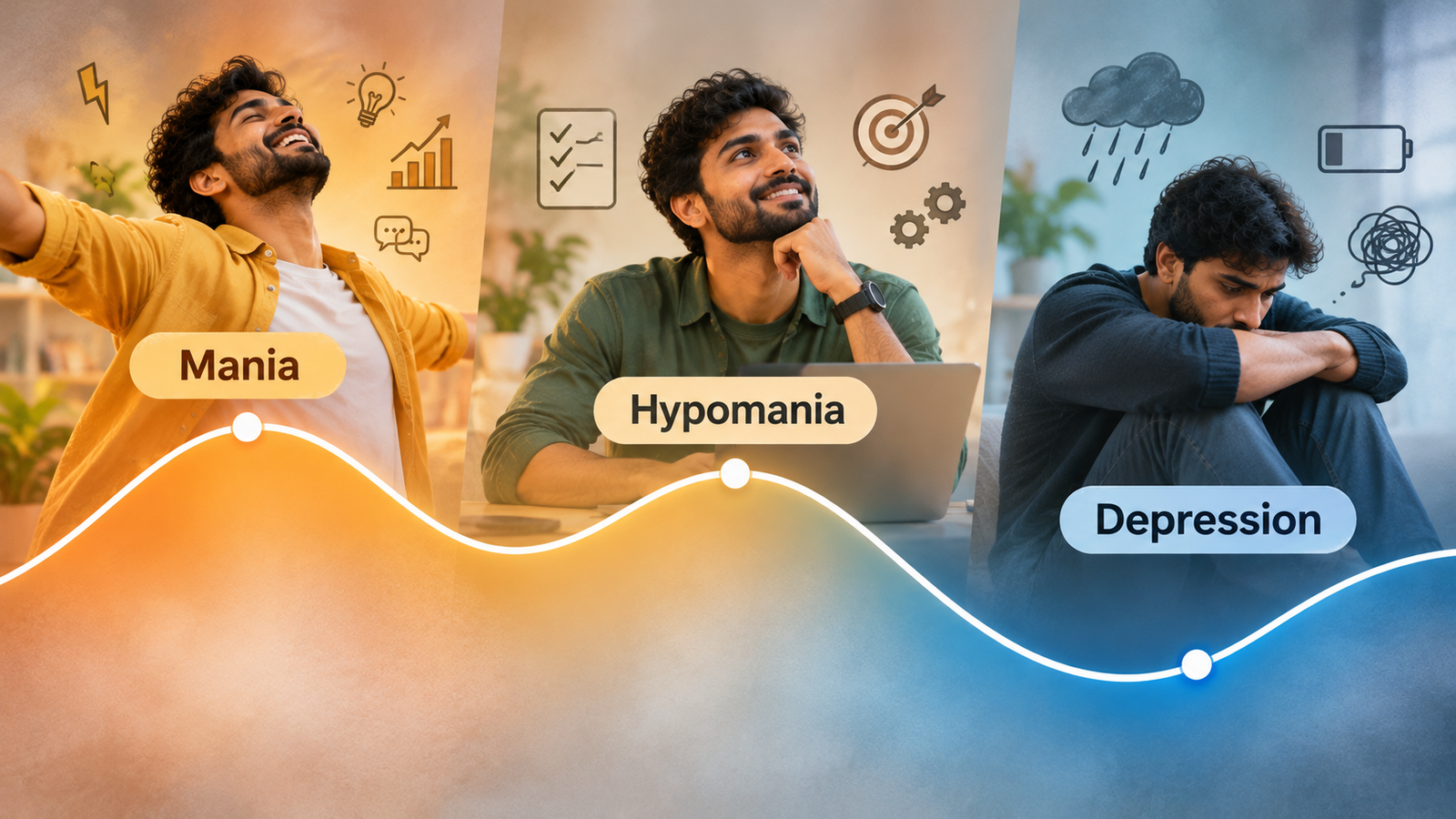
Everyone’s mood goes up and down. But in bipolar disorder, the shifts go well beyond ordinary ups and downs: weeks of unusual energy, little need for sleep and risky decisions, followed by weeks of exhaustion, hopelessness and withdrawal. Because the low phases are often what people seek help for, bipolar disorder is frequently mistaken for depression, and can go unrecognised for years.
This guide explains the symptoms of bipolar disorder in each mood state, how they differ across the types, early warning signs, how it looks in different people, and when to get help. It is general information, not medical advice or a diagnosis.
In short
- Bipolar disorder involves distinct episodes of abnormally high mood and energy (mania or hypomania) and episodes of depression, usually with periods of more stable mood in between.
- Manic symptoms include little need for sleep, racing thoughts, fast speech, inflated confidence and risky behaviour. Depressive symptoms include persistent low mood, loss of interest, fatigue and hopelessness.
- There are three main types: bipolar I, bipolar II and cyclothymic disorder.
- Many people spend more time depressed than manic, so it is often misdiagnosed as depression.
- It is treatable, and early help makes a big difference. If you are thinking about suicide, call Tele-MANAS (14416) or 112.
What is bipolar disorder?
Bipolar disorder, once called manic depression, is a mood disorder recognised in the DSM-5-TR and the WHO’s ICD-11. It is characterised by episodes of mania or hypomania and, in most people, episodes of major depression. The World Health Organization estimates that around 40 million people worldwide live with it. It usually begins in the late teens or early adulthood, and is lifelong but manageable with treatment.
Symptoms of mania
Mania is a period of abnormally elevated, expansive or irritable mood together with increased energy or activity, lasting at least a week or needing hospital care. For a full guide, see what is mania disorder. Typical symptoms include:
| Area | What you may notice |
|---|---|
| Mood | Feeling unusually “high,” euphoric or wired, or very irritable and easily angered |
| Energy and sleep | Much less need for sleep with no tiredness, restlessness and a constant drive to be active |
| Thoughts and speech | Racing thoughts, jumping between ideas, talking very fast or constantly, being easily distracted |
| Self-image | Inflated confidence, feeling special or all-powerful, grand plans |
| Behaviour | Overspending, reckless driving, risky sex, gambling, sudden business or travel plans, quitting jobs, taking on too many projects |
| Severe mania | Delusions (for example, believing you have special powers or a mission), hallucinations, confusion or aggression. This needs urgent care. |
Symptoms of hypomania
Hypomania is a milder form of elevated mood and energy, lasting at least four days. The person is clearly different from their usual self, but functioning is not seriously impaired, there are no psychotic symptoms and hospital care isn’t needed. It can feel good, which is why it is often not recognised as a problem.
- More energy, talkativeness and confidence than usual
- Needing less sleep but feeling fine
- Being more creative, sociable or productive than usual
- More impulsive spending or decisions
- Others notice the change, even if the person doesn’t mind it
Hypomania often leads into either mania or depression, so recognising it matters.
Symptoms of bipolar depression
Depressive episodes in bipolar disorder last at least two weeks and can be severe. They often look like major depression:
| Area | What you may notice |
|---|---|
| Mood | Persistent sadness, emptiness, hopelessness, or feeling numb or irritable |
| Interest and enjoyment | Losing interest in things you usually enjoy |
| Energy | Fatigue, slowed movement and thinking, feeling heavy or “weighed down” |
| Sleep and appetite | Sleeping too much or too little, appetite and weight changes |
| Thinking | Guilt, worthlessness, trouble concentrating or deciding, negative thoughts about the future |
| Safety | Thoughts of death or suicide |
Clues that depression may be bipolar include onset at a young age, sleeping a great deal, a family history of bipolar disorder, a history of high-energy periods, and depression that doesn’t improve or gets worse with antidepressants alone. See also is depression a mental disorder and have there been times when you felt depressed or hopeless.
Mixed features and rapid cycling
Mixed features mean symptoms of mania and depression occur together or in quick succession, for example racing thoughts, agitation and restlessness combined with hopelessness and low self-worth. It can be especially distressing and carries a higher risk of suicide, so it needs prompt assessment.
Rapid cycling means four or more mood episodes within a year. It is more common in some people, including women, and can be triggered by sleep disruption, substance use and some medicines.
Types of bipolar disorder
| Type | Key features |
|---|---|
| Bipolar I disorder | At least one manic episode (lasting at least a week or needing hospital care). Depressive episodes are common but not required for diagnosis. |
| Bipolar II disorder | At least one hypomanic episode and at least one major depressive episode, but never full mania. Depression is often the main burden. |
| Cyclothymic disorder | For at least two years in adults, many periods of hypomanic and depressive symptoms that don’t meet the criteria for full episodes |
| Other specified bipolar disorders | Bipolar-type symptoms that don’t match the above, including those caused by substances or medical conditions |
“Bipolar II” is not a milder form. The depressive episodes can be disabling, and the risks are real.
Early warning signs of an episode
Learning your own early signs helps you act before a full episode develops. Common ones include:
| Heading towards mania or hypomania | Heading towards depression |
|---|---|
| Needing less sleep without tiredness | Sleeping too much or struggling to get up |
| Feeling unusually energised or “speedy” | Losing energy and motivation |
| Talking faster, or being hard to interrupt | Withdrawing from people and activities |
| Irritability or feeling “on edge” | Tearfulness, flatness or irritability |
| Starting lots of projects, or big spending | Neglecting tasks and self-care |
| Racing thoughts | Negative thoughts, guilt and hopelessness |
A simple daily mood and sleep diary can reveal patterns early, and is useful to show a doctor.
Between episodes
Many people with bipolar disorder have periods of stable mood, sometimes lasting months or years, particularly with treatment. Others have lingering symptoms such as low mood, poor sleep, anxiety or difficulty concentrating between episodes. Both are part of the condition, and ongoing treatment aims to extend the well periods and reduce lingering symptoms.
Symptoms in different people
| Group | What may be different |
|---|---|
| Children and teenagers | Extreme irritability and mood swings, explosive anger, very high energy or decreased need for sleep, risky behaviour, school problems. It can be mistaken for ADHD, conduct problems or ordinary adolescence. See what is ADHD and its symptoms |
| Women | More frequent depressive episodes, rapid cycling and mixed features, with episodes sometimes linked to hormonal changes, pregnancy and the postpartum period. Postpartum mania or psychosis is an emergency. |
| Men | More often present with manic episodes, and may be diagnosed later when risky behaviour or substance use brings attention |
| Older adults | Symptoms may look like dementia or depression. New mania in later life often has a medical cause or is medicine-related, so a thorough review is needed |
Is it bipolar disorder or something else?
| Condition | How it differs |
|---|---|
| Normal mood swings | Respond to events, last hours to days, and don’t wreck sleep, work or relationships. Bipolar episodes last days to weeks and are out of proportion or disconnected from circumstances. |
| Major depression (unipolar) | Depression without any history of mania or hypomania. Treatment differs, so the distinction matters. |
| Borderline personality disorder | Rapid emotional shifts, often within hours and triggered by relationship events, as part of a long-standing pattern, rather than distinct episodes lasting days or weeks. The two can occur together. |
| ADHD | Restlessness and impulsivity are lifelong and constant, not episodic |
| Substance-induced mood changes | Alcohol, cannabis, stimulants and some medicines can cause manic or depressive symptoms, and need to be assessed |
| Medical causes | Thyroid disease, steroid medicines and neurological conditions can cause mood episodes |
| Schizophrenia and other psychoses | Psychosis occurs without the clear mood episodes of bipolar disorder. See schizophrenia |
How is bipolar disorder diagnosed?
A psychiatrist makes the diagnosis by talking with the person and, ideally, a family member, and reviewing the history of mood episodes. Because people usually seek help during depression, it is important to ask about past periods of high energy, reduced sleep and unusual behaviour. Screening questionnaires such as the Mood Disorder Questionnaire can help but cannot diagnose. Tests may be done to rule out medical causes such as thyroid problems. On average, it often takes years to get an accurate diagnosis, so persistence matters.
If you’d like a private starting point, our confidential self-screening is available for mental health concerns. It is not a diagnosis.
What causes bipolar disorder?
- Genetics: it runs strongly in families
- Brain function and chemistry
- Triggers for episodes: sleep loss, stress, major life events, alcohol and drug use, some medicines (including antidepressants taken without a mood stabiliser in some people), and hormonal changes
It is not caused by weak character, bad parenting or “too much emotion.”
How is bipolar disorder treated?
Bipolar disorder is a long-term condition that responds well to ongoing treatment. Approaches include mood-stabilising medicines such as lithium and certain anticonvulsants, antipsychotic medicines, psychoeducation, therapy (including cognitive behavioural therapy and interpersonal and social rhythm therapy), regular routines and sleep, avoiding alcohol and drugs, and family support. Medicines must be prescribed and monitored by a psychiatrist, and should never be stopped suddenly, even when you feel well. For more, see what is mania disorder, our schools of therapy and how to stay mentally healthy.
Bipolar disorder and substance use
Alcohol and drug use are very common alongside bipolar disorder. Some people use substances to dampen highs, lift lows or sleep. Alcohol, cannabis and stimulants can trigger or worsen episodes, disrupt sleep and make medicines less effective. When both are present, treating them together gives the best results. See dual diagnosis, is binge drinking bad and how to come out of addiction. If someone drinks heavily every day, don’t stop suddenly without medical advice, as withdrawal can be dangerous. See how to detox your body from alcohol.
Suicide risk
People with bipolar disorder have a higher risk of suicide than the general population, particularly during depressive and mixed episodes and soon after an episode ends. Please take any talk of death, hopelessness or self-harm seriously. Many people recover from these feelings with treatment and support.
If you are thinking about ending your life, or you are worried about someone who is, please act now. Stay with them if you can. In India, Tele-MANAS (14416) is a free national helpline, and in an emergency you can call 112 or go to the nearest hospital.
Practical tips for India
- “Moody” or “bad behaviour.” Mood episodes are often misread as laziness, a bad attitude or a “phase.” Persistent, extreme changes deserve a medical check.
- Depression treated alone. Many people are first prescribed antidepressants for depression. If you have also had high-energy periods, tell your doctor.
- Ritual and delay. Some families first seek spiritual remedies. Faith can comfort, but early medical treatment protects health, work and relationships.
- Stigma and “log kya kahenge.” Fear of gossip and its effect on marriage and jobs keeps many families silent. Confidential services exist, and the Mental Healthcare Act, 2017 protects patients’ rights.
- Medication continuity. Some medicines need regular blood tests. Plan follow-up, and ask about availability and cost.
- Free support. Tele-MANAS (14416) offers free tele-mental-health support in India.
When to get professional help
Please speak to a doctor or mental health professional if:
- You’ve had periods of unusually high energy, little need for sleep and risky behaviour, even if they felt good
- Low mood is lasting two weeks or more, or antidepressants don’t seem to help
- Mood swings are affecting your work, studies, money or relationships
- You are using alcohol or drugs to manage your mood
- There is a family history of bipolar disorder and you notice changes
- You have thoughts of suicide or self-harm
Call 112 or go to the nearest hospital if someone is aggressive, threatening, hasn’t slept for days and is confused, has delusions or hallucinations, is putting themselves or others in danger, or talks about suicide.
Special situations
After childbirth. Mania or psychosis soon after having a baby is a medical emergency. Seek urgent help.
Pregnancy. Medicines need careful review by a doctor. Don’t stop them without advice.
Anxiety alongside bipolar disorder. This is common. See is anxiety a psychological disorder.
Sleep problems. Poor sleep can both trigger and signal episodes. See types of sleep disorders.
When coping starts to harm
- Drinking or using cannabis or stimulants to “even out” your mood
- Skipping medicine because the energy of a high feels good, or because you feel well
- Staying up all night on projects, social media or gambling
- Taking on loans or credit during highs
- Withdrawing from family and ignoring warning signs
If this sounds familiar, it is a sign to reach out, not a reason for shame.
If you’re worried about someone else
Describe what you’ve noticed, calmly and without blame, such as “You’ve hardly slept in four days and you seem very wound up.” Encourage a doctor’s visit, offer to go along, and keep notes of changes in sleep and behaviour, which can help a clinician. Protect finances and safety where you can, and look after your own wellbeing too.
How Thamarai can help
Mood disorders often occur alongside alcohol, cannabis or other drug use, sleep problems, anxiety and stress. At Thamarai Healing Center in Pollachi, our mental health program offers confidential, personalised assessment and guidance, and support for co-occurring mental health conditions and substance use, with family involvement, in a calm setting among the foothills of the Western Ghats. If you are worried about someone, a confidential conversation can help you understand the next step, including whether they need a psychiatrist’s assessment.
Speak to our team confidentially →
Frequently asked questions
What are the symptoms of bipolar disorder?
Episodes of mania or hypomania, with high or irritable mood, little need for sleep, racing thoughts and risky behaviour, and episodes of depression, with low mood, loss of interest, fatigue and hopelessness. Mood is more stable between episodes.
What are the early signs of bipolar disorder?
Changes in sleep, unusual energy or irritability, mood shifts that are out of character, sudden big plans or spending, and episodes of low mood that don’t lift, often beginning in the late teens or early twenties.
What is the difference between bipolar I and bipolar II?
Bipolar I involves at least one full manic episode. Bipolar II involves hypomania, which is milder, together with major depressive episodes, but never full mania.
What is the difference between bipolar disorder and depression?
Depression involves low mood only. Bipolar disorder also involves episodes of mania or hypomania, and treatment differs, so an accurate diagnosis matters.
How long do bipolar episodes last?
Mania lasts at least a week or until treated, hypomania at least four days and depression at least two weeks, though many last weeks to months without treatment.
Can bipolar disorder be treated?
Yes. Mood stabilisers and other medicines, therapy, regular routines and family support help control episodes and prevent relapse. Treatment is usually long-term.
Can bipolar disorder start in childhood or the teens?
Yes. It often begins in the late teens or early adulthood, but can begin earlier, and is sometimes mistaken for ADHD or conduct problems.
Is treatment at Thamarai confidential?
Yes. Enquiries, assessments and treatment are handled confidentially, and you can call to ask questions without committing to anything.
This article is for general information and isn’t a substitute for professional medical advice, diagnosis or treatment. If someone is in danger, call 112.
Sources
- American Psychiatric Association. Diagnostic and Statistical Manual of Mental Disorders, Fifth Edition, Text Revision (DSM-5-TR). 2022. Bipolar and Related Disorders.
- World Health Organization. International Classification of Diseases, 11th Revision (ICD-11), 6A60 to 6A62 Bipolar and related disorders. World Health Organization. Bipolar disorder fact sheet.
- National Institute for Health and Care Excellence (NICE). Bipolar disorder: assessment and management (CG185). 2014.
- Grande I, Berk M, Birmaher B, Vieta E. Bipolar disorder. The Lancet, 2016.
- Hirschfeld RMA, et al. Development and validation of a screening instrument for bipolar spectrum disorder: the Mood Disorder Questionnaire. American Journal of Psychiatry, 2000.
- Government of India. Mental Healthcare Act, 2017.
- Ministry of Health and Family Welfare, Government of India. Tele-MANAS (14416).