
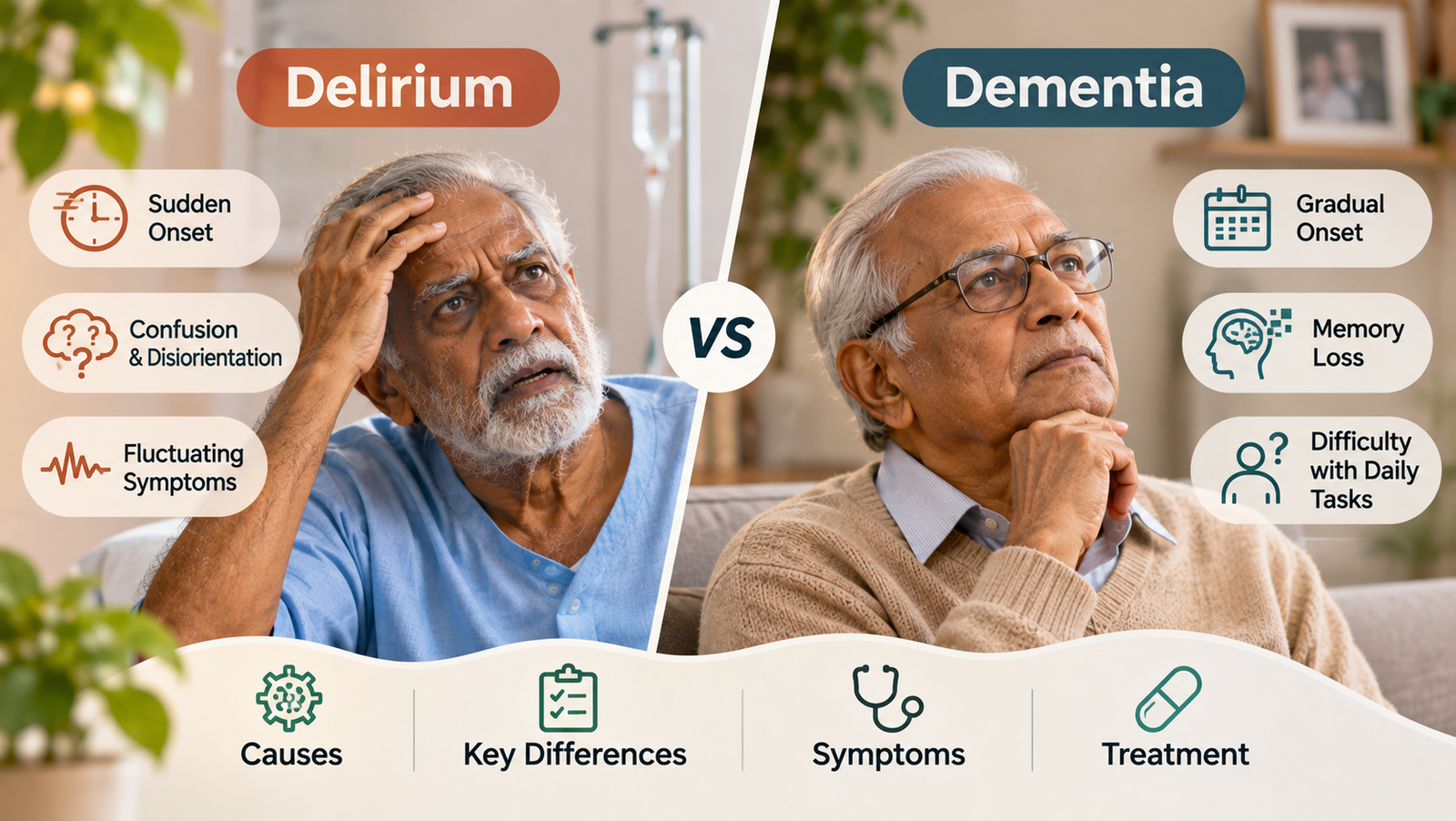
An elderly mother who was chatting normally yesterday is suddenly confused today. She doesn’t recognise the room, drifts in and out of conversation and says she sees people who aren’t there. The family wonders: is this dementia getting worse? Often it isn’t. It may be delirium, a sudden and often reversible medical emergency that is frequently mistaken for dementia or dismissed as “just old age.”
This guide explains the differences between delirium and dementia, how they can occur together, the causes, what treatment looks like and what families can do. It is general information, not medical advice or a diagnosis.
In short
- Delirium comes on suddenly (hours to days), fluctuates and is usually caused by a treatable medical problem. It is a medical emergency, and often reversible.
- Dementia develops gradually (months to years), is progressive and is caused by long-term brain disease. Most types can’t be cured.
- The key difference is attention and alertness. In delirium they are disturbed and fluctuate, while in early dementia alertness is usually normal.
- Delirium is common in people with dementia, and a sudden change in someone with dementia should always be checked.
- Infections, dehydration, medicines, pain, surgery and alcohol or drug withdrawal are common triggers. Call 112 for sudden confusion.
What is delirium?
Delirium is a sudden change in mental state, with disturbed attention and awareness, together with changes in thinking such as memory problems, disorientation or hallucinations. It develops over hours to days, tends to fluctuate through the day (often worse in the evening and at night) and is caused by an underlying medical condition, medicine, substance or withdrawal. It is recognised in the DSM-5-TR and the WHO’s ICD-11. It is common in hospitalised older people, in intensive care and after surgery, and it is a sign that the brain is under severe physical stress.
What is dementia?
Dementia is a group of conditions in which long-term damage to the brain gradually affects memory, thinking, language, judgement and behaviour, severe enough to interfere with daily life. It develops slowly and worsens over time. Common types include Alzheimer’s disease, vascular dementia, Lewy body dementia and frontotemporal dementia. For more, see is there a cure for dementia.
Delirium vs dementia: the key differences
| Delirium | Dementia | |
|---|---|---|
| Onset | Sudden, over hours to days | Gradual, over months to years |
| Course | Fluctuates through the day, often worse at night | Slowly progressive, with relatively stable day-to-day symptoms |
| Attention | Markedly impaired. Can’t focus, easily distracted. | Usually normal in early stages |
| Alertness | Altered: drowsy, or agitated and hyper-alert, and may swing between | Usually normal until late stages |
| Awareness | Reduced awareness of surroundings | Preserved until later stages |
| Hallucinations and delusions | Common, often visual | Less common early on, except in Lewy body dementia |
| Sleep-wake cycle | Often disturbed or reversed | May be disturbed, especially later |
| Cause | An acute medical problem, medicine, substance or withdrawal | Long-term brain disease |
| Duration | Days to weeks, sometimes longer in older adults | Permanent and progressive |
| Reversibility | Often reversible if the cause is found and treated | Most types can’t be reversed or cured |
| How urgent? | Medical emergency | Needs assessment and planning, but not usually an emergency |
Delirium, dementia and depression
Depression in older adults can also cause poor concentration and memory, sometimes called “pseudodementia,” and can be confused with both.
| Delirium | Dementia | Depression | |
|---|---|---|---|
| Onset | Sudden | Gradual | Weeks to months, often linked to a life event |
| Main feature | Confusion and disturbed attention | Memory and thinking decline | Low mood, loss of interest, slowed thinking |
| Awareness | Disturbed | Preserved early | Preserved |
| How the person answers | Rambling or incoherent | Tries to answer, often wrongly | Often says “I don’t know” |
See is depression a mental disorder. Because they overlap and can occur together, a doctor needs to assess.
Delirium on top of dementia
People with dementia are much more likely to develop delirium, and delirium can be missed because confusion is already part of their condition. Warning signs include a sudden change from their usual self: new or worse confusion, drowsiness, restlessness, hallucinations, refusing food or drink, or a change in sleep. A family member who knows their usual baseline is often the first to notice. Delirium can speed up decline in dementia, which makes early recognition and treatment important.
Symptoms of delirium
| Area | What you may notice |
|---|---|
| Attention | Can’t focus or follow a conversation, easily distracted, has to be asked questions repeatedly |
| Awareness and thinking | Confusion about time, place or people, muddled or rambling speech, poor memory of recent events |
| Perception | Seeing or hearing things that aren’t there, or believing things that aren’t true, such as being harmed |
| Alertness and activity | Agitation, restlessness and pulling at lines or bedclothes, or the opposite: unusual drowsiness and withdrawal |
| Sleep | Awake at night, sleepy by day |
| Mood | Fear, anxiety, irritability or sudden emotional changes |
| Type | What it looks like |
|---|---|
| Hyperactive | Agitated, restless, sometimes aggressive, with hallucinations. Easier to spot. |
| Hypoactive | Quiet, drowsy, slow and withdrawn. Often missed, or mistaken for depression, tiredness or “settling down.” |
| Mixed | Swings between the two |
What causes delirium?
Delirium usually has more than one cause. Common triggers include:
| Cause | Examples |
|---|---|
| Infections | Urinary tract infection, chest infection, other infections, fever |
| Dehydration and body chemistry | Low fluids, low or high sodium, low blood sugar, kidney or liver problems |
| Medicines | Sedatives, sleeping tablets, strong painkillers, some antihistamines and bladder medicines, and combinations of many medicines |
| Surgery and hospital stay | Anaesthesia, pain, ICU, disrupted sleep, unfamiliar surroundings |
| Brain and heart conditions | Stroke, bleeding, head injury, low oxygen, heart or lung problems |
| Alcohol and drugs | Intoxication, withdrawal from alcohol or sedatives, drug use |
| Other | Constipation, urinary retention, uncontrolled pain, lack of sleep, missing glasses or hearing aids |
People at higher risk include older adults, people with dementia, those with several medical conditions or taking many medicines, hearing or vision loss, and people who drink heavily.
Alcohol, drugs and delirium
Alcohol and drugs are a major but under-recognised cause of delirium at any age.
- Alcohol withdrawal delirium (delirium tremens) can occur in people who drink heavily and stop or cut down suddenly, usually about two to three days after the last drink. It involves severe confusion, hallucinations, fever, a racing heart and agitation, and it is a life-threatening emergency that needs hospital care. See how to detox your body from alcohol.
- Confusion in people who drink heavily can also signal a vitamin B1 (thiamine) deficiency state, known as Wernicke’s encephalopathy, which also needs urgent treatment.
- Withdrawal from sedatives such as benzodiazepines, and intoxication or withdrawal from other drugs, can cause delirium.
- Hospital patients who drink may develop withdrawal delirium after admission. Telling the doctors honestly about alcohol or drug use helps them prevent and treat it.
Long-term heavy drinking can also cause lasting memory problems. See is there a cure for dementia for alcohol-related brain damage. For substance use that is affecting health, see how to come out of addiction and dual diagnosis. If someone drinks heavily every day, don’t stop suddenly without medical advice.
How is delirium diagnosed?
Doctors diagnose delirium by observing the person and gathering information, and family input is crucial. The assessment typically includes:
- History from family or carers: what is new, when it began, how the person was before, and their medicines, alcohol and drug use
- Bedside tests of attention and awareness, using tools such as the Confusion Assessment Method (CAM) or the 4AT
- A physical examination, including temperature, pulse, blood pressure, oxygen level, hydration and signs of infection or pain
- Tests to find the cause, such as blood and urine tests, and sometimes a chest X-ray, ECG or brain scan
- A medicine review to identify culprits
How is delirium treated?
The most important step is to find and treat the cause.
| Approach | What it does |
|---|---|
| Treat the cause | Antibiotics for infection, fluids for dehydration, correcting body chemistry, treating pain, managing withdrawal |
| Review medicines | Stopping or adjusting those that can cause confusion, under medical supervision |
| Supportive care | Hydration, nutrition, mobilising, bowel and bladder care, good sleep, a quiet and well-lit room by day and dark and calm at night |
| Orientation and familiarity | Clocks and calendars, familiar faces and objects, glasses and hearing aids, calm explanations |
| Medicines for severe distress | A doctor may prescribe a short course of medicine when someone is severely distressed or a danger to themselves or others and calming approaches haven’t worked. Specific medicines are used for alcohol or sedative withdrawal. These must always be prescribed and monitored by a doctor. |
| Avoiding restraint | Physical restraints can worsen delirium and are avoided where possible |
Delirium often clears within days to a few weeks once the cause is treated, though in older adults and people with dementia recovery can take longer, and some people don’t return fully to their previous level. Delirium is linked with a higher risk of long-term cognitive decline, especially in those already vulnerable, which is why prevention and prompt treatment matter.
Can delirium be prevented?
- Keep well hydrated and eat regularly
- Review medicines regularly with a doctor, and avoid unnecessary sedatives and sleeping tablets
- Treat infections, pain and constipation early
- Keep glasses, hearing aids and dentures available and in use
- Protect sleep, and keep a day-night routine
- Encourage gentle movement and getting out of bed in hospital
- Have a familiar person present, and orientation cues such as a clock
- Be honest with doctors about alcohol and drug use before surgery or hospital admission
What families can do
| Helpful | Not helpful |
|---|---|
| Tell the doctor straight away: “This is a sudden change from how they usually are” | Assuming “it’s just old age” or “the dementia is getting worse” |
| Describe their usual baseline and when things changed | Waiting several days to see if it settles |
| Bring a list of all medicines, including over-the-counter, herbal and Ayurvedic ones, and mention alcohol or drug use honestly | Hiding drinking or tablets for fear of judgement |
| Stay calm, speak simply and reassure | Arguing with their beliefs, shouting or scolding |
| Stay with them if possible, and bring glasses, hearing aids and familiar objects | Leaving them alone, in the dark or in a noisy environment |
| Encourage fluids and food, and help them move | Forcing food or drink if they are drowsy and may choke |
| Ask the team to check for delirium | Giving extra sleeping tablets or sedatives on your own |
Practical tips for India
- “It’s just old age.” Sudden confusion in an elderly relative is often dismissed. It should be treated as a medical emergency.
- Infections and dehydration. Urinary and chest infections, and dehydration during hot weather or fasting, are common triggers in older adults.
- Many medicines from many doctors. Bring everything to one doctor for review, including over-the-counter pain relievers, sleeping tablets and herbal remedies.
- Chemist sedatives. Sleeping tablets and sedatives are easy to buy and can trigger confusion in older adults.
- Hospital stays. Family presence is often possible and helpful. Ask staff how you can help with orientation and routine.
- Alcohol history. Don’t hide it from the doctors. Withdrawal in hospital can be dangerous, and treatment is far more effective when staff know.
- Free support. Tele-MANAS (14416) offers free tele-mental-health support in India, including for stressed caregivers.
When to get urgent help
Call 112 or go to the nearest hospital if:
- There is sudden confusion, disorientation or a marked change from the person’s usual state
- They are very drowsy, hard to wake, or can’t pay attention at all
- They have hallucinations, severe agitation or are a danger to themselves or others
- They have a high fever, seizure, stroke signs (face drooping, arm weakness, slurred speech), head injury or breathing difficulty
- Confusion follows stopping or cutting down heavy drinking or sedatives
- They are refusing all food and fluids
Don’t wait for it to pass. Delirium is a sign that the body is seriously unwell.
Special situations
After surgery. Delirium is common, especially in older adults. Tell the team about previous confusion, dementia, alcohol use and medicines before surgery.
In intensive care. Delirium is very common. Hospitals aim to reduce sedation, promote sleep and mobilise patients where possible.
In people with known dementia. Any sudden change deserves medical review.
In younger people. Delirium can occur at any age, particularly with infection, drug intoxication or alcohol and drug withdrawal.
Sleep problems. Poor sleep can worsen confusion. See types of sleep disorders.
Looking after yourself as a caregiver
Seeing someone you love suddenly confused is frightening. You may feel guilt, exhaustion and fear. Share responsibilities, rest, eat, and talk to someone you trust. If you are caring for someone with dementia, support groups and organisations such as the Alzheimer’s and Related Disorders Society of India (ARDSI) offer information and community. See how to stay mentally healthy.
How Thamarai can help
Delirium is a medical emergency that needs hospital care, and Thamarai Healing Center is not a substitute for it. Where alcohol or drug use is involved, including the risks of withdrawal, our alcohol addiction and detoxification care offers medically guided support in a calm setting among the foothills of the Western Ghats, and our mental health program offers confidential assessment and guidance for families. If you are worried about someone who drinks heavily and plans to stop, a confidential conversation can help you plan safely.
Speak to our team confidentially →
Frequently asked questions
What is the difference between delirium and dementia?
Delirium comes on suddenly, over hours to days, fluctuates and is caused by an acute medical problem, with disturbed attention and alertness. Dementia develops gradually over months to years and is a progressive brain disease, with attention and alertness usually normal early on.
Can delirium turn into dementia?
Delirium isn’t dementia, but it is linked with a higher risk of long-term cognitive decline, especially in older adults and those with existing brain vulnerability. People with dementia are also more likely to develop delirium.
Is delirium reversible?
Often yes. Treating the underlying cause usually clears delirium within days to weeks, though recovery can take longer in older adults and people with dementia.
Is delirium an emergency?
Yes. Sudden confusion is a sign that the body is seriously unwell and needs urgent medical assessment. Call 112 or go to the nearest hospital.
What causes delirium?
Infections, dehydration, medicines, surgery, pain, stroke, low oxygen, body chemistry problems, and alcohol or drug intoxication or withdrawal are common causes, often in combination.
Can alcohol cause delirium?
Yes. Heavy drinkers who stop suddenly can develop alcohol withdrawal delirium (delirium tremens), a life-threatening emergency, and heavy drinking can also cause other confusional states such as Wernicke’s encephalopathy.
How can I tell if my parent has delirium or dementia?
Look at timing and attention. A sudden change over hours or days, trouble focusing and fluctuating alertness suggest delirium and need urgent medical review. A slow decline over months or years suggests dementia and needs assessment.
Is treatment at Thamarai confidential?
Yes. Enquiries, assessments and treatment are handled confidentially, and you can call to ask questions without committing to anything.
This article is for general information and isn’t a substitute for professional medical advice, diagnosis or treatment. Sudden confusion is an emergency: call 112.
Sources
- American Psychiatric Association. Diagnostic and Statistical Manual of Mental Disorders, Fifth Edition, Text Revision (DSM-5-TR). 2022. Neurocognitive Disorders: Delirium.
- World Health Organization. International Classification of Diseases, 11th Revision (ICD-11), 6D70 Delirium. World Health Organization. Dementia fact sheet.
- National Institute for Health and Care Excellence (NICE). Delirium: prevention, diagnosis and management (CG103).
- Inouye SK, Westendorp RG, Saczynski JS. Delirium in elderly people. The Lancet, 2014.
- Wilson JE, et al. Delirium. Nature Reviews Disease Primers, 2020.
- Inouye SK, et al. Clarifying confusion: the Confusion Assessment Method. Annals of Internal Medicine, 1990.
- Ministry of Health and Family Welfare, Government of India. Tele-MANAS (14416).