
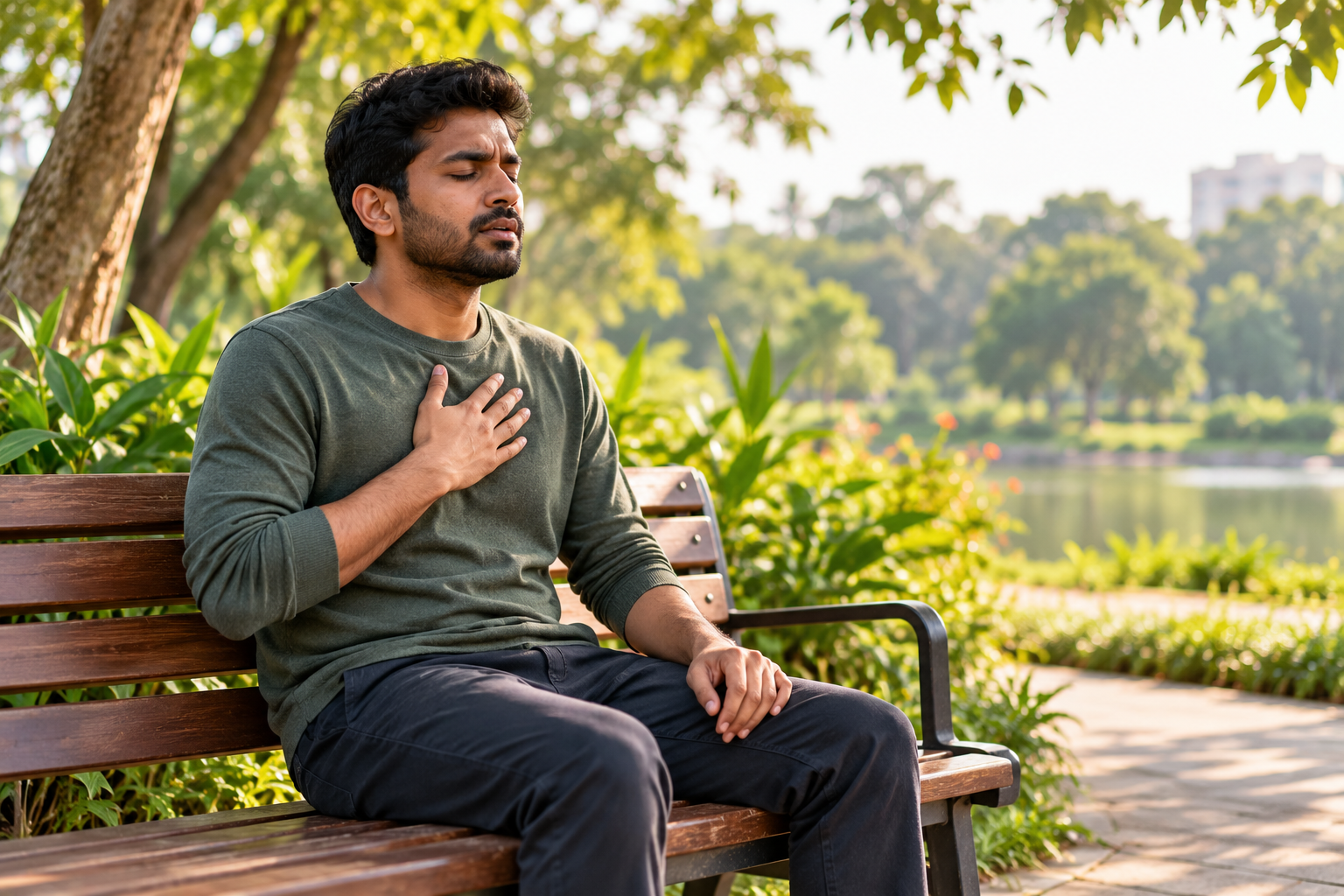
A panic attack can arrive without warning: a pounding heart, tight chest, shaky hands, a wave of dread that makes you feel you are about to collapse or lose control. If you have had one, you know how real and frightening it feels. If you’ve watched someone else have one, you may not have known what you were seeing or how to help.
This guide explains what a panic attack looks like from the outside and feels like from the inside, how long it lasts, how it differs from a heart attack, what to do during one, and when to get help. It is general information, not medical advice or a diagnosis.
In short
- A panic attack is a sudden surge of intense fear or discomfort that usually peaks within minutes, with physical and mental symptoms such as a racing heart, breathlessness, trembling and a sense of doom.
- From the outside it can look like rapid breathing, sweating, trembling, paleness or flushing, and a frightened, desperate-to-escape expression.
- It feels dangerous but is not harmful in itself and passes, usually within about 20 to 30 minutes.
- Panic can mimic a heart attack. If you are unsure, or it is the first time, call 112 or get urgent medical help.
- Panic attacks and panic disorder are very treatable.
What is a panic attack?
A panic attack is an abrupt surge of intense fear or discomfort that reaches a peak within minutes and involves several physical and psychological symptoms. It happens when the body’s alarm system, the “fight or flight” response, fires when there is no real danger, or far out of proportion to it. Heart rate and breathing speed up, muscles tense and the mind registers an emergency.
Many people have at least one panic attack at some point in their lives, often during a period of stress. A single attack does not mean you have a disorder.
What does a panic attack look like?
Panic attacks can look very different from the outside and the inside. Often the person is far more distressed than they appear.
| From the outside (what others may see) | From the inside (what the person feels) |
|---|---|
| Fast, shallow breathing or gasping | Breathlessness, a feeling of being unable to get enough air, or choking |
| Sweating, trembling or shaking | Pounding or racing heart, chest tightness or pain |
| Pale or flushed face | Dizziness, light-headedness, feeling faint |
| Wide, frightened eyes and a desperate expression | Overwhelming fear, a sense of doom or that something terrible is about to happen |
| Clutching the chest, throat or head | Fear of having a heart attack, of dying or of “going crazy” |
| Trying to leave, pacing or seeking air | An urge to escape, or feeling trapped |
| Difficulty speaking, crying or going very quiet | Feeling detached from yourself or surroundings, as if things are unreal |
| Holding on to someone, or sitting or lying down suddenly | Tingling, numbness, nausea or stomach upset, hot or cold flushes |
Some people go quiet and still instead. Not everyone who is panicking looks dramatic, and you can’t judge how bad it feels from how it looks.
Common symptoms of a panic attack
Clinicians generally describe a panic attack as involving four or more of these symptoms coming on abruptly:
| Area | Symptoms |
|---|---|
| Heart and breathing | Pounding or racing heart, shortness of breath, feeling of choking, chest pain or discomfort |
| Body | Sweating, trembling or shaking, nausea or abdominal distress, dizziness or light-headedness, chills or hot flushes, tingling or numbness |
| Mind | Feeling detached from yourself or things around you, fear of losing control or “going crazy,” fear of dying |
How long does a panic attack last?
Most panic attacks build quickly, usually peaking within about 10 minutes, and ease within about 20 to 30 minutes. Afterwards, many people feel drained, shaky or on edge for hours. Attacks that seem to last much longer are often a series of waves. The attack itself does not cause lasting physical harm.
Panic attack or heart attack?
Panic can feel exactly like a heart problem, and it is not possible to be sure from symptoms alone. If this is your first time, if you have heart disease or risk factors, or if you are unsure, treat chest pain as an emergency and call 112 or get to a hospital. It is always better to be checked.
| Panic attack | Heart attack | |
|---|---|---|
| Onset | Often abrupt, sometimes after a stressor or fear | May build gradually or be triggered by exertion |
| Chest pain | Sharp or stabbing, may be felt in the centre or left chest | Pressure, squeezing or heaviness that may spread to the arm, jaw, neck or back |
| Duration | Usually peaks within minutes and eases within about 20 to 30 minutes | Can persist or keep returning |
| Other signs | Tingling, hyperventilation, a sense of unreality and intense fear | Cold sweat, nausea, breathlessness, weakness, pain spreading to the arm or jaw |
| What to do | Use calming strategies, then seek a medical check, especially the first time | Call 112 immediately |
These differences are only a rough guide, and both can overlap. Don’t try to diagnose yourself.
Panic attack, anxiety attack and panic disorder
| Term | What it means |
|---|---|
| Panic attack | A sudden, intense surge of fear with physical and mental symptoms, peaking within minutes |
| “Anxiety attack” | A common phrase, but not a formal diagnosis. It usually describes anxiety that builds gradually in response to worry or stress and may be less intense and shorter-lived than panic. |
| Panic disorder | A diagnosis in which a person has repeated, unexpected panic attacks and, for at least a month, persistent worry about having more, or changes in behaviour to avoid them |
Panic attacks can also occur in other conditions such as social anxiety, phobias, PTSD and depression. For the wider picture of anxiety, see our guide on whether anxiety is a psychological disorder.
What causes panic attacks?
Panic attacks have no single cause. They often reflect a mix of:
- Stress and life changes, such as loss, conflict, job or exam pressure
- A tendency towards anxiety, which can run in families
- Misreading body sensations, such as a faster heartbeat, as dangerous, which fuels more fear
- Caffeine, nicotine and lack of sleep, which can make the body more reactive
- Alcohol, cannabis and other drugs, including during withdrawal or the “comedown,” which can trigger panic
- Medical conditions or medicines, such as thyroid problems, heart rhythm problems, asthma or some medicines, so a medical check is sensible
- Trauma or ongoing fear, which keeps the alarm system on high alert
Attacks can occur out of the blue, in a specific situation such as a crowd or a lift, or even during sleep, waking you with intense fear.
What to do during a panic attack
- Remind yourself what it is. Say, “This is a panic attack. It feels awful, but it is not dangerous, and it will pass.”
- Stay where you are if it’s safe. Fleeing can teach your brain that the place was dangerous. If you’re driving, pull over safely.
- Slow your breathing. Breathe in gently through your nose and out slowly, for a little longer than you breathe in. If breathing exercises make you feel worse, use another technique.
- Ground yourself. Name five things you can see, four you can touch, three you can hear. Press your feet into the floor.
- Loosen tight clothing and sit or lean on something steady.
- Don’t fight it. Trying to force it away often makes it stronger. Let the wave rise and fall.
- Afterwards, rest and be kind to yourself. Drink some water, and take it easy for a while.
| Helpful | Not helpful |
|---|---|
| Slow, gentle breathing | Breathing into a paper bag, which can reduce oxygen and is not recommended |
| Grounding with the senses | Gulping air or deliberate fast breathing |
| Staying put and riding it out | Escaping every time, which can reinforce fear |
| Telling someone you trust | Alcohol, sedatives or other substances “to calm down” |
| A short walk once it eases | Self-diagnosing a heart problem without checking |
How to help someone having a panic attack
- Stay calm and stay with them. Your calm helps.
- Speak slowly and simply: “I’m here. You’re safe. This will pass.”
- Move to a quieter place if you can, and give them space to breathe.
- Ask what helps, and offer to breathe slowly together or count out loud.
- Don’t say “calm down” or “it’s all in your head.” It doesn’t help and can feel dismissive.
- Don’t crowd them, and ask others to step back.
- Call 112 if they have chest pain that doesn’t ease, have a known heart condition, are struggling to breathe, faint, or if you are unsure.
Myths about panic attacks
| Myth | What’s true |
|---|---|
| “A panic attack can kill you.” | Panic attacks feel dangerous but don’t cause death or harm themselves. A medical check can rule out other causes. |
| “They mean you’re going crazy.” | Panic attacks are common and are not a sign of psychosis or losing your mind. |
| “You can just stop it by relaxing.” | Trying to force calm can backfire. Skills and treatment help over time. |
| “They’re just attention-seeking.” | Panic attacks are involuntary, frightening and exhausting. |
| “If I avoid the place, I’ll be safe.” | Avoidance brings relief now but tends to widen the fear over time. |
How are panic attacks treated?
Panic attacks and panic disorder respond well to treatment, and many people improve substantially.
| Approach | What it does |
|---|---|
| Cognitive behavioural therapy (CBT) | Helps you understand panic, change fearful interpretations of body sensations and gradually face feared situations and sensations. See our schools of therapy. |
| Medication | Antidepressants such as SSRIs and SNRIs are commonly prescribed for panic disorder. Some sedatives can cause dependence, so they are generally used only briefly and under supervision. Never stop medicines suddenly. |
| Lifestyle changes | Regular sleep, movement, less caffeine and alcohol and stress management. See exercise for mental health and how to stay mentally healthy. |
| Relaxation and mindfulness | Skills that help you notice sensations without panicking. See mindfulness for wellbeing. |
| Treating co-occurring conditions | Addresses depression, trauma, alcohol or drug use alongside panic |
Practical tips for India
- Repeated casualty visits. Many people go to the emergency room or cardiologist several times with chest pain or breathlessness and are told “nothing is wrong, it’s just stress.” A check is sensible, but it’s also worth asking about panic and anxiety treatment.
- Physical symptoms. Panic is often described as heart, stomach or breathing trouble rather than fear. Tell your doctor about stress and fear too.
- Spiritual explanations. Some families look to spiritual causes. Faith can comfort, but a medical check and evidence-based treatment matter alongside it.
- Stigma and “log kya kahenge.” Fear of judgement delays help. Choose one or two trusted people, and confidential services.
- Exams, work and family pressure. These are common triggers. Early support helps students and professionals.
- Free support. Tele-MANAS (14416) offers free tele-mental-health support in India.
When to get professional help
Please see a doctor after a first panic attack, to rule out physical causes. Speak to a doctor or mental health professional if:
- You have repeated panic attacks, or fear having another
- You avoid places, activities or people because of panic
- Attacks wake you from sleep
- Panic affects your work, studies, sleep or relationships
- You are using alcohol, drugs or sedatives to cope
- You feel low, hopeless or have thoughts of self-harm
Call 112 or go to the nearest hospital for chest pain that is severe, spreading to the arm or jaw, or doesn’t ease, for fainting, or if you are unsure it is panic. If you are thinking about ending your life, please reach out now. In India, Tele-MANAS (14416) is a free national helpline.
Special situations
Alcohol and panic. Alcohol may seem to calm nerves, but the “comedown” and withdrawal can trigger panic and anxiety. If you drink heavily and feel panicky when you cut down, speak to a doctor before stopping suddenly. See how to detox your body from alcohol.
Cannabis and other drugs. Some drugs can trigger panic attacks or intense anxiety, and withdrawal can too. See how to come out of addiction.
Night-time panic. Waking with a racing heart and dread is common in panic disorder. Treatment helps.
Panic with depression, trauma or OCD. These often occur together. See is depression a mental disorder, how to deal with trauma and how can I know if I have OCD.
Children and teenagers. Panic may appear as sudden fear, crying, stomach aches or refusing school. Take it seriously and involve a professional.
When coping starts to harm
Fear of the next attack can lead to habits that keep panic going. Be alert if you notice:
- Avoiding more and more places, such as markets, buses, lifts or crowds
- Never going out alone, or always carrying “safety” items
- Drinking, using drugs or taking sedatives to stay calm
- Constantly checking your pulse or symptoms
- Cutting down on exercise or coffee-free days out of fear
If this sounds familiar, it is a sign to reach out, not a reason for shame.
How Thamarai can help
At Thamarai Healing Center in Pollachi, our mental health program offers confidential, personalised care built around a comprehensive assessment, evidence-based therapies, support for co-occurring conditions such as anxiety, depression and addiction, family involvement and structured aftercare, in a calm setting among the foothills of the Western Ghats. You can also explore our Wellness Center and Activities.
If panic is affecting your life, a confidential conversation is a good place to start. Speak to our team confidentially →
Frequently asked questions
What does a panic attack look like?
From the outside it can look like rapid breathing, sweating, trembling, a pale or flushed face, clutching the chest and a frightened expression. Inside, it feels like a racing heart, breathlessness, dizziness, dread and fear of dying or losing control.
How long does a panic attack last?
Most peak within about 10 minutes and ease within about 20 to 30 minutes. You may feel drained or shaky for hours afterwards.
How can I tell if it’s a panic attack or a heart attack?
They can feel very similar and can’t be reliably told apart by symptoms alone. If it’s your first time, you have heart risk factors, or you’re unsure, call 112 or get urgent medical help.
Can a panic attack be dangerous?
Panic attacks feel frightening but are not harmful in themselves. A medical check can rule out other conditions that cause similar symptoms.
What should I do during a panic attack?
Remind yourself that it will pass, stay put if safe, slow your breathing gently, ground yourself with your senses and avoid fighting it. Don’t breathe into a paper bag.
How do I help someone having a panic attack?
Stay calm, speak slowly, move to a quiet place, ask what helps and breathe slowly together. Avoid “calm down,” and call 112 if you are unsure or the chest pain doesn’t ease.
What is the difference between a panic attack and an anxiety attack?
A panic attack is a sudden, intense surge of fear that peaks within minutes. “Anxiety attack” isn’t a formal diagnosis and usually describes anxiety that builds more gradually, though many people use the terms interchangeably.
Is treatment at Thamarai confidential?
Yes. Enquiries, assessments and treatment are handled confidentially, and you can call to ask questions without committing to anything.
This article is for general information and isn’t a substitute for professional medical advice, diagnosis or treatment. If you have chest pain or are unsure whether it is panic, seek urgent medical help.
Sources
- American Psychiatric Association. Diagnostic and Statistical Manual of Mental Disorders, Fifth Edition, Text Revision (DSM-5-TR). 2022. Panic Disorder and Panic Attack specifier.
- World Health Organization. International Classification of Diseases, 11th Revision (ICD-11), Panic disorder.
- National Institute for Health and Care Excellence (NICE). Generalised anxiety disorder and panic disorder in adults: management (CG113).
- Clark DM. A cognitive approach to panic. Behaviour Research and Therapy, 1986.
- Barlow DH. Anxiety and Its Disorders. 2nd ed. Guilford Press, 2002.
- Ministry of Health and Family Welfare, Government of India. Tele-MANAS (14416).