
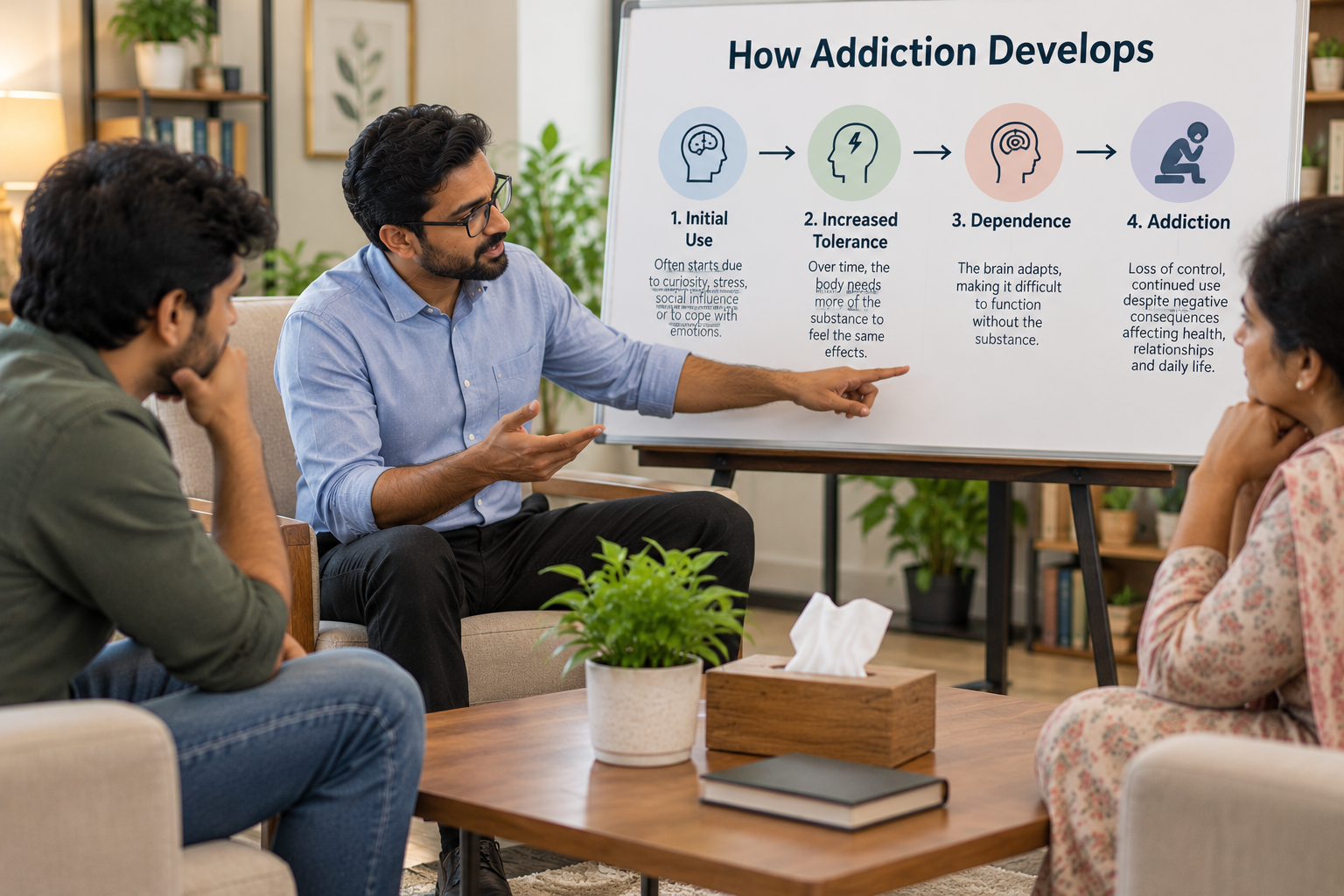
Most people who have ever taken a drug, or been prescribed a strong medicine, don’t become addicted. Yet some do, sometimes quickly and sometimes after years, and from the outside it can be hard to understand why. Families ask “why couldn’t they just stop?” People living with it often ask the same question about themselves.
This guide explains how addiction develops: what happens in the brain, which factors raise the risk, the common pathways into it, and why it is best understood as a health condition rather than a failure of character. It is general information, not medical advice.
In short
- Addiction usually develops gradually, from use, to regular use, to loss of control. It is not a single decision or a single event.
- Drugs act on the brain’s reward, learning, stress and self-control systems, and repeated use can change how those systems work.
- Risk comes from a combination of factors: genes, age at first use, mental health, trauma, environment and the drug itself. No single factor decides the outcome.
- Many people begin with a prescription, social use, or an attempt to cope with stress, anxiety or low mood.
- Addiction is treatable. Recovery is more likely with early help, and with treatment of any mental health conditions alongside it.
Does everyone who uses drugs become addicted?
No. Many people try a substance, or take a prescribed medicine, and never develop a problem. Whether someone does depends on a mix of factors, some they can influence and many they cannot. This is why addiction can’t be explained by “weak willpower,” and why two people with similar exposure can have very different outcomes.
What happens in the brain
The brain has systems that reward behaviours important for survival, such as eating, bonding and rest. Many drugs act on these same reward pathways, causing a stronger, faster surge of the chemical signal involved (dopamine) than everyday pleasures do.
According to NIDA and to Volkow and colleagues in the New England Journal of Medicine, repeated drug use can gradually change several connected brain systems:
- Reward. The brain adapts, so everyday pleasures feel less rewarding, and the drug becomes the main source of reward.
- Learning and memory. The brain links the drug to people, places, moods and routines, so cues can trigger powerful urges, sometimes long after someone has stopped.
- Stress. Over time, the brain’s stress systems can become more reactive, so that discomfort, irritability and anxiety rise when the drug is absent, and using starts to feel like relief rather than pleasure.
- Self-control. The brain regions involved in judgement and impulse control can become less effective, making it harder to resist urges even when someone sincerely wants to stop.
Major health bodies describe addiction as a chronic, relapsing condition involving these changes, which is why willpower alone is often not enough. Scientists continue to study the details, and models of addiction are still being refined.
How addiction typically develops: the stages
Addiction rarely appears overnight. Clinicians often describe a gradual progression, though the pace varies enormously from person to person and drug to drug, and some people move through it in weeks while others take years.
- Experimentation. First use, usually influenced by curiosity, peers, social setting, stress or a prescription.
- Regular use. Use becomes more frequent, often tied to particular situations, moods or routines, such as to relax, socialise or sleep.
- Risky use. Use continues despite warning signs, in riskier situations or in larger amounts, and it starts to cause problems.
- Dependence. The body adapts, so a person needs more for the same effect (tolerance) and feels unwell without it (withdrawal). Our guide to addiction, dependence and tolerance explains the difference in detail.
- Addiction. Compulsive use continues despite serious harm, with a loss of control that the person often struggles to reverse alone.
Not everyone reaches the last stages, and recovery is possible from any of them. Earlier help generally means less harm.
What raises the risk
Risk factors are not destiny. They describe higher likelihood, and most people with several risk factors never develop an addiction. The main groups are:
Biological factors
- Genes. NIDA estimates that genetic factors account for roughly 40 to 60 percent of a person’s vulnerability to addiction, which is why addiction often runs in families, though it never guarantees an outcome.
- Age at first use. Starting in the teenage years carries higher risk, because the brain’s self-control systems are still developing. See our guide to teen substance use and family therapy.
- The drug itself. Drugs differ in how strongly and quickly they affect the brain, and in how readily they lead to dependence.
Psychological factors
- Mental health conditions. Anxiety, depression, ADHD, trauma-related conditions and other difficulties raise the risk, and substance use can also worsen them.
- Difficulty coping. Using a substance to manage stress, loneliness, boredom or pain can become a habit that is hard to replace.
- Trauma and adverse childhood experiences.
Social and environmental factors
- Family history of substance use, and family conflict or instability
- Peer influence
- Easy availability and social acceptance of use
- High stress, such as exam pressure, unemployment, bereavement or relationship breakdown
- Isolation or lack of support
Protective factors work in the other direction: supportive family relationships, a sense of belonging at school or in the community, healthy ways of coping, early help for mental health difficulties, and clear, caring boundaries.
Common pathways into addiction
People arrive at addiction by many routes. Some of the most common:
1. Social and peer use. Use that starts in social settings and gradually becomes regular.
2. Prescribed medicines. Some people become dependent on a medicine that was prescribed for a genuine reason, such as pain, anxiety or sleep. This is not a personal failing. It reflects how these medicines act on the body. Our guides on prescription drug addiction and opioid addiction and withdrawal explain this pathway.
3. Self-medication. Using a substance to blunt anxiety, low mood, trauma symptoms or stress. It can bring short-term relief and long-term harm. Our guide to dual diagnosis explains why the two conditions often occur together.
4. Using to cope with trauma or emotional pain.
5. Using to perform or stay awake. Some people begin using substances to stay alert, work longer or cope with pressure.
6. Escalation from a “lighter” to a “heavier” substance or pattern, which can happen gradually and isn’t inevitable.
Why “just stop” is rarely enough
Several things make stopping hard, even for someone who badly wants to:
- Cravings and cues can be triggered by people, places or moods, long after the last use.
- Withdrawal, whether physical or emotional, can be intensely uncomfortable, and some withdrawals are medically dangerous, which is why supervision matters.
- The underlying reasons for use, such as anxiety, trauma or pain, are still there until they are treated.
- Shame and secrecy often delay asking for help.
None of this means recovery is out of reach. It means effective treatment addresses all of these, not just the drug use.
Warning signs that use may be becoming a problem
- Using more, or for longer, than intended
- Wanting to cut down and being unable to
- Needing more for the same effect
- Feeling unwell or distressed when not using
- Spending a lot of time getting, using or recovering from the substance
- Neglecting work, study, family or other interests
- Continuing despite clear harm to health, relationships or money
- Hiding or lying about use
- Using in risky situations
A cluster of these, over time, is a reason to speak to a professional.
Can addiction be prevented?
Not entirely, but risk can be reduced. Evidence-based approaches include:
- Open, non-judgemental family communication, especially with children and teenagers
- Early support for mental health difficulties, including anxiety, depression and trauma
- Responsible prescribing and use of medicines, taking them as directed, and storing them safely
- Strong connections with school, community and friends
- Building healthy coping skills for stress and difficult emotions
- Seeking help early if use begins to cause concern
What recovery involves
Addiction is treatable, and many people recover. Effective treatment usually combines:
- A full medical and psychiatric assessment
- Medically supervised detoxification where withdrawal needs managing
- Therapy, such as cognitive behavioural therapy and motivational approaches
- Treatment of any mental health condition alongside the addiction
- Family involvement and education
- Ongoing support and a relapse prevention plan
If you need help right now
- In an emergency, such as an overdose, seizure, chest pain or loss of consciousness, call 112 immediately.
- If you feel hopeless or are having thoughts of harming yourself, the free national tele-mental-health helpline Tele-MANAS (14416) offers support in India.
How Thamarai can help
At Thamarai Healing Center in Pollachi, treatment begins with a comprehensive medical and psychiatric assessment, so that the full picture, including any co-occurring mental health condition, is understood before a plan is made. Our drug addiction treatment programme, with medically supervised detoxification where needed, is delivered by a multidisciplinary team in a private, residential setting, and includes family involvement and structured aftercare.
If you’re trying to understand what is happening to you or someone you love, a confidential conversation is a good place to start. Speak to our team confidentially →
Frequently asked questions
How do people get addicted to drugs?
Usually gradually. Repeated use changes the brain’s reward, learning, stress and self-control systems, and a mix of genetic, psychological and social risk factors makes some people more vulnerable. Addiction can begin with social use, a prescription, or an attempt to cope with distress.
Is addiction a choice?
The first use is often a choice, but addiction is not simply a continuing choice. As the brain changes, control over use becomes impaired, which is why major health bodies describe it as a chronic health condition.
Why do some people get addicted and others don’t?
Because risk depends on many factors working together, including genetics, age at first use, mental health, trauma, environment and the specific substance. No single factor decides it.
Can someone get addicted to prescribed medicine?
Yes. Some prescribed medicines carry a risk of dependence and, in some people, addiction, particularly with long-term or high-dose use. Never stop a prescribed medicine suddenly without speaking to the prescribing doctor.
How long does it take to become addicted?
There’s no set timeline. It varies enormously by person, substance and circumstances, and for some people it develops over years while for others it can be faster.
Can teenagers get addicted more easily?
Teenagers are generally more vulnerable, because the brain’s self-control systems are still maturing. They also tend to respond well to early, supportive intervention.
Can addiction be treated?
Yes. Assessment, supervised detox where needed, therapy, treatment of any mental health condition, family involvement and ongoing support all help many people recover.
This article is for general information and isn’t a substitute for professional medical advice, diagnosis or treatment.
Sources
- National Institute on Drug Abuse (NIDA). Drugs, Brains, and Behavior: The Science of Addiction and Understanding Drug Use and Addiction (DrugFacts).
- Volkow ND, Koob GF, McLellan AT. Neurobiologic advances from the brain disease model of addiction. New England Journal of Medicine, 2016.
- American Psychiatric Association. Diagnostic and Statistical Manual of Mental Disorders, Fifth Edition, Text Revision (DSM-5-TR). 2022.
- World Health Organization. International Classification of Diseases, 11th Revision (ICD-11): disorders due to substance use.
- SAMHSA. Facing Addiction in America: The Surgeon General’s Report on Alcohol, Drugs, and Health.