
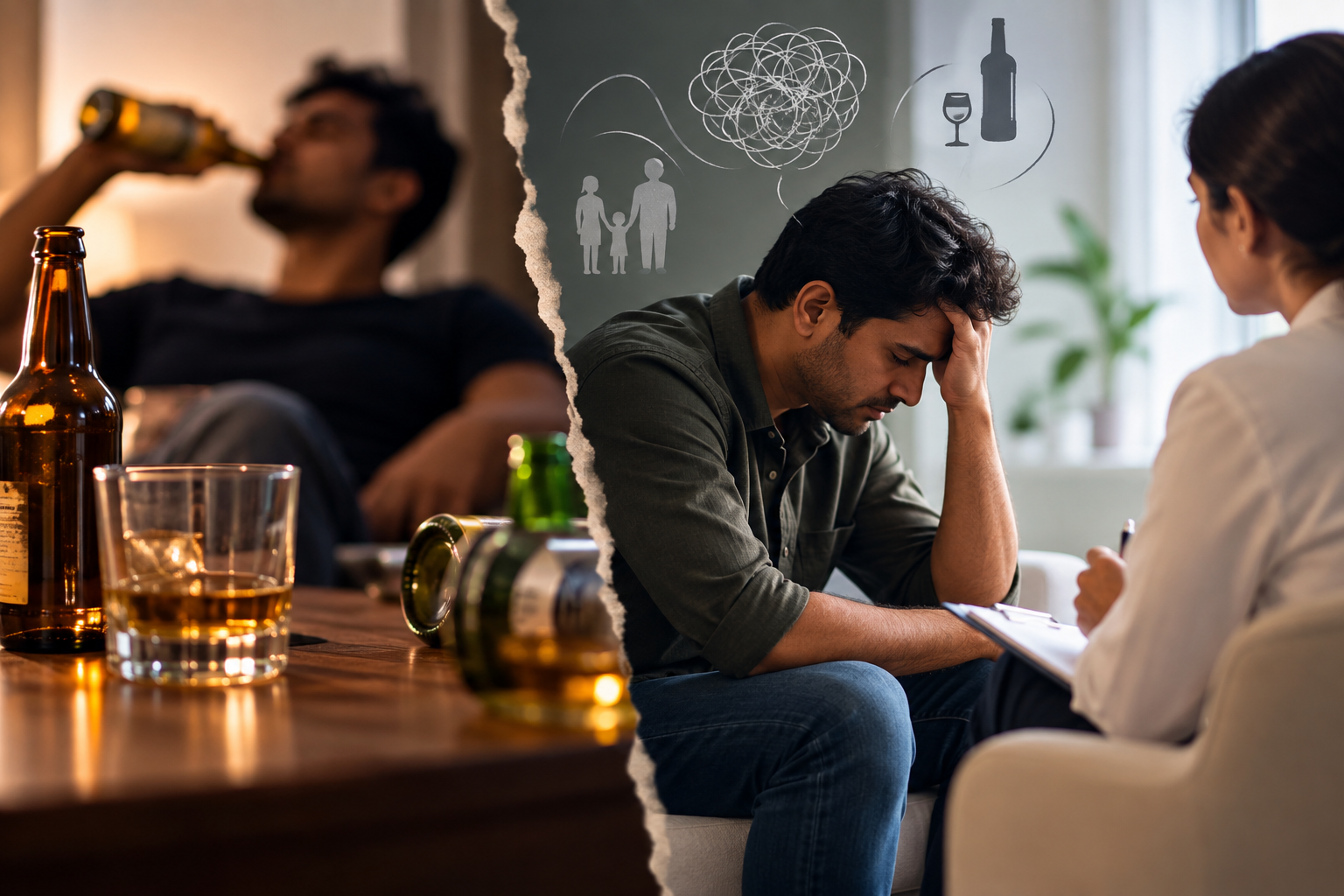
Most people who drink heavily don’t stop to ask whether they have a problem until someone close to them does, or a doctor’s report raises a flag. If you’re reading this, you may be wondering about your own drinking or a family member’s.
This guide explains the difference between heavy drinking and alcohol use disorder (AUD), the signs clinicians look for, and when it makes sense to talk to a professional. It is not a diagnosis. Only a qualified clinician can make one.
In short
- Heavy drinking describes how much and how often someone drinks. Alcohol use disorder is a medical condition marked by loss of control, harm and dependence.
- Doctors use 11 criteria. Two or three means mild, four or five moderate, and six or more severe.
- Struggling to cut down, withdrawal symptoms, or drinking that harms health, work or family are all reasons to seek help.
- After long-term heavy drinking, stopping suddenly can be dangerous. Speak to a doctor first.
- AUD is treatable. Effective care combines medical support, therapy and relapse prevention.
What is the difference between heavy drinking and alcohol use disorder?
Heavy drinking is a description of quantity and frequency. Health bodies such as the National Institute on Alcohol Abuse and Alcoholism (NIAAA) and the World Health Organization (WHO) publish definitions of risky or heavy drinking. Those numbers depend on the country, the size of a “standard drink”, and a person’s age, sex and health. A limit taken from a foreign guideline doesn’t always map neatly onto the pegs and bottles people actually pour in India.
Alcohol use disorder is a diagnosis. It describes a pattern: difficulty controlling drinking, continuing despite harm, needing more to feel the same effect, or feeling unwell without alcohol. WHO’s ICD-11 draws a similar line between a “harmful pattern of alcohol use” and “alcohol dependence”.
Two things follow from this:
- Someone can drink heavily without meeting the criteria for AUD. They are still at higher risk of health problems and of developing AUD.
- Someone can have AUD without drinking every day. Weekend binges where stopping feels impossible can qualify.
How doctors diagnose alcohol use disorder: the 11 criteria
The American Psychiatric Association’s DSM-5-TR lists eleven criteria. In plain language, in the past 12 months has the person:
- Drunk more, or for longer, than they intended?
- Wanted to cut down or stop, or tried and couldn’t?
- Spent a lot of time drinking, getting alcohol, or recovering from its effects?
- Had strong cravings or urges to drink?
- Let drinking get in the way of responsibilities at work, school or home?
- Kept drinking despite problems it causes or worsens in relationships?
- Given up or cut back on activities that used to matter?
- Drunk in situations that are physically risky, such as before driving?
- Kept drinking despite knowing it is causing or worsening a physical or mental health problem?
- Needed more alcohol to get the same effect (tolerance)?
- Had withdrawal symptoms, or drunk to relieve or avoid them?
Two or three of these suggests mild AUD, four or five moderate, and six or more severe. A clinician looks at the whole picture. That includes your health and any physical dependence, and they may use a structured screening tool such as the WHO’s AUDIT (Alcohol Use Disorders Identification Test).
Warning signs that heavy drinking may be turning into alcohol use disorder
These questions aren’t a clinical test, but they can help you notice a pattern:
- Have you promised yourself or others to cut down, and not managed it?
- Does “just one” regularly turn into many?
- Do you hide, minimise or lie about how much you drink?
- Do you plan your day around drinking, or feel irritable when you can’t?
- Do you feel shaky, sweaty, anxious or unable to sleep when you skip a drink?
- Has a doctor mentioned an alcohol-related concern, such as abnormal liver tests?
- Have family members, friends or colleagues raised worries?
If several of these sound familiar, that is a good reason for a professional assessment.
When it may be time to seek treatment
Consider getting help if:
- You’ve tried to cut down or stop and couldn’t.
- You feel physically unwell when you stop or cut back, with shaking, sweating, anxiety or disturbed sleep.
- Drinking is harming your health, work, money or relationships, and you continue anyway.
- A doctor has raised an alcohol-related health concern.
- You’ve had treatment before and returned to drinking. This is common and doesn’t mean failure. It usually means the plan needs adjusting, and a good relapse prevention programme is built for exactly that.
- You’re also dealing with depression, anxiety, trauma or sleep problems. Treating these together tends to work better than treating them separately.
Important safety note on stopping. For people who have drunk heavily over a long period, stopping suddenly can cause withdrawal. Symptoms range from shakiness and anxiety to seizures and confusion in serious cases, and can be life-threatening. Don’t quit abruptly on your own. Speak to a doctor about medically supervised detoxification. If someone has a seizure, severe confusion or hallucinations after stopping drinking, call 112 immediately.
What treatment for alcohol use disorder can involve
There is no single route. Care usually combines several of these:
- A full assessment, medical and psychiatric, to understand severity, withdrawal risk and any co-occurring conditions.
- Medically supervised detox, where needed, so withdrawal is managed safely.
- Talking therapies. NIAAA describes behavioural treatments such as cognitive behavioural therapy and motivational enhancement therapy, along with family counselling and brief interventions.
- Medication, prescribed and monitored by a doctor, which helps some people reduce drinking or stay abstinent.
- Relapse prevention and aftercare, so support continues once formal treatment ends.
- Family involvement, because recovery is easier when the people around you understand what’s happening.
Wellness practices such as yoga, mindfulness and good nutrition can support recovery. They work alongside medical and psychological care, not in place of it.
The right level of care, from outpatient to residential, depends on assessment. Residential care is often recommended when withdrawal risk is high, drinking is severe, home support is limited or there have been repeated relapses.
Common myths about problem drinking
- “I only drink at weekends, so it can’t be a problem.” The pattern and the harm matter, not just the number of days.
- “I can hold my drink, so I’m fine.” Needing more alcohol to feel the same effect (tolerance) is one of the diagnostic criteria.
- “You have to hit rock bottom first.” There’s no need to wait. Earlier help usually means less harm to health and relationships.
- “It’s just a lack of willpower.” Long-term heavy drinking changes how the brain handles reward, stress and self-control, which is why willpower alone often isn’t enough.
Talking to someone about their drinking
If you’re worried about a family member, choose a calm moment. Describe specific things you’ve noticed rather than using labels, speak from your own concern (“I’m worried because…”), and offer to go with them to a doctor. If they aren’t ready, that’s common. Motivational approaches are designed for people who feel unsure. Our guide on how to talk to a parent or spouse about getting help for addiction has practical wording.
How Thamarai can help
At Thamarai Healing Center in Pollachi, alcohol treatment begins with a comprehensive medical and physical check. Psychiatric, nutritional and lifestyle assessments follow, and your doctors build a plan around your situation. Detoxification is medically supervised where needed, and care is delivered by a multidisciplinary team in a private residential setting.
You can read about our Alcohol Addiction Treatment programme, or if you’re not sure what you need, a confidential conversation is a low-pressure place to start. Speak to our team confidentially →
Frequently asked questions
Is heavy drinking the same as alcohol use disorder?
No. Heavy drinking describes quantity and frequency, while AUD is a diagnosis based on loss of control, harm and dependence. Heavy drinking raises the risk of AUD but doesn’t always mean it is present.
Can I have alcohol use disorder if I don’t drink every day?
Yes. Diagnosis depends on the pattern of symptoms over the past year, not on daily drinking.
How do I know how severe it is?
A clinician counts how many of the 11 criteria apply (mild, moderate or severe) and also considers your physical health, withdrawal risk and support at home.
Is alcohol use disorder treatable?
Yes. Effective treatments exist, and many people recover. The right combination and timeline vary from person to person. Relapse can happen and doesn’t mean treatment has failed.
Do I need to go to rehab?
Not always. A professional assessment decides the right level of care, from outpatient support to residential treatment.
This article is for general information and isn’t a substitute for professional medical advice, diagnosis or treatment.
Sources
- American Psychiatric Association. Diagnostic and Statistical Manual of Mental Disorders, Fifth Edition, Text Revision (DSM-5-TR). 2022.
- World Health Organization. International Classification of Diseases, 11th Revision (ICD-11): disorders due to use of alcohol.
- NIAAA. Alcohol Use Disorder: A Comparison Between DSM-IV and DSM-5.
- NIAAA. Treatment for Alcohol Problems: Finding and Getting Help.
- Babor T. et al. / WHO. AUDIT: The Alcohol Use Disorders Identification Test, Guidelines for Use in Primary Care.