
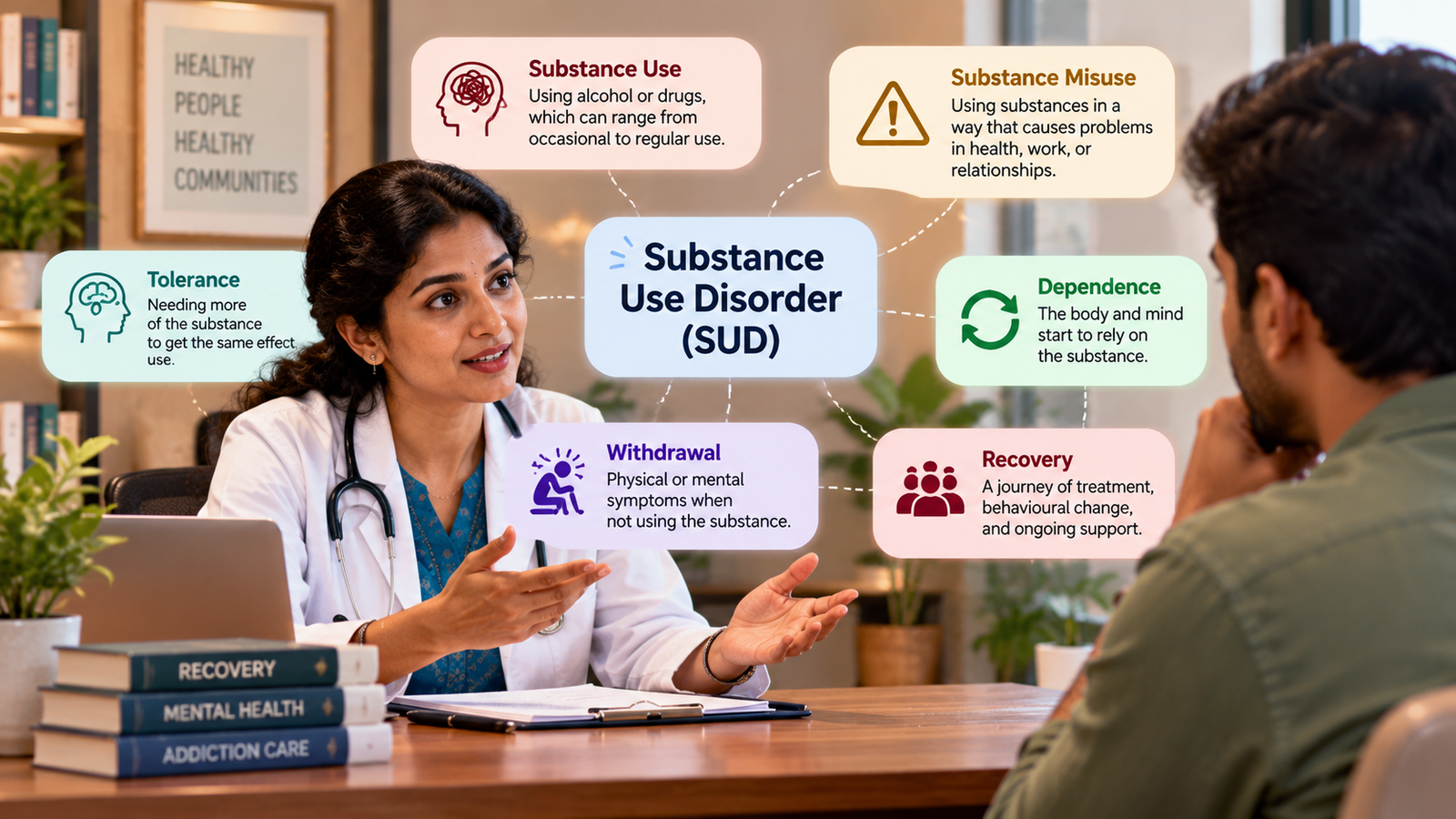
“Addiction,” “dependence,” and “tolerance” get used almost interchangeably in everyday conversation, and that mixing up of terms can cause real confusion. Someone might say “I’m not addicted, I’m just dependent,” or “I’ve built up a tolerance, so I must be addicted,” without realising these are three distinct, if related, concepts in medicine.
This guide explains what each term actually means, how they connect, and why the distinctions matter for understanding treatment. It is general information, not a diagnostic tool. Only a qualified clinician can assess where someone stands.
In short
- Tolerance means needing more of a substance to get the same effect. It can happen with medicines used exactly as prescribed.
- Dependence means the body has adapted to a substance and reacts with withdrawal symptoms if it’s stopped or reduced. It can also occur with appropriately prescribed medicine.
- Addiction (formally, substance use disorder) is a diagnosable medical condition marked by compulsive use despite harm, and by loss of control.
- You can have tolerance or dependence without having addiction. Addiction usually, but not always, involves both.
- These distinctions matter because they change how a clinician assesses and treats someone.
Why this confusion matters
The confusion isn’t just semantic. It affects real decisions: a person taking a prescribed painkiller who develops dependence may fear they’ve “become an addict,” when what they’re experiencing is a known, expected physical adaptation that a doctor can manage safely. Meanwhile, someone who genuinely has a substance use disorder might minimise it by saying “I could stop any time, I’m just used to it,” conflating tolerance with the much narrower idea of “getting used to something.”
Clinicians rely on these distinctions, drawn from frameworks like the American Psychiatric Association’s DSM-5-TR and the WHO’s ICD-11, to understand what’s actually happening and to plan appropriate care.
Tolerance: needing more for the same effect
Tolerance describes a physical process: with repeated use, the body adapts, so a given amount of a substance produces less effect than it once did. To get the same effect, a person needs a higher amount.
Tolerance is common and can develop with:
- Alcohol and recreational drugs
- Prescribed medicines, including some pain medicines and sedatives, when taken as directed over time
- Even substances like caffeine
Tolerance on its own is not addiction. A person taking a prescribed sleep medicine under medical supervision who develops tolerance to it is not, by that fact alone, addicted. Their doctor may adjust the dose, switch medicines, or plan a supervised reduction. This is a routine part of medical care for certain medicines, not a sign of a disorder.
Dependence: the body’s adaptation, and withdrawal if stopped
Dependence goes a step further than tolerance. It describes a state where the body has adapted to the ongoing presence of a substance, such that stopping or reducing it triggers withdrawal symptoms, physical or psychological effects that occur because the substance is no longer there.
Like tolerance, dependence can occur without addiction. This is well recognised in medicine. For example:
- A person prescribed certain pain medicines after surgery, taken exactly as directed, can become physically dependent and experience withdrawal symptoms if the medicine is stopped abruptly, which is why doctors often taper such medicines gradually.
- Some medicines used for anxiety or sleep carry a similar pattern of dependence with appropriate long-term use.
In these situations, the medical approach is usually a carefully managed, gradual reduction under supervision, not treatment for addiction.
When does dependence overlap with addiction? In substance use disorder, dependence often exists alongside the compulsive, harmful pattern of use described below. But the WHO’s ICD-11 makes a point of distinguishing “harmful pattern of use” and “dependence syndrome” as related but separate diagnostic concepts. This is also why the newer DSM-5-TR framework moved away from using “dependence” as the primary diagnostic term for addiction, precisely because it was so often confused with the physical dependence that can occur without addiction.
Addiction (substance use disorder): loss of control and continued use despite harm
Addiction, which clinicians now more precisely call substance use disorder, is a diagnosable medical condition. The DSM-5-TR describes it through a pattern of symptoms occurring together, which broadly cluster into:
- Impaired control: using more, or for longer, than intended; unsuccessful efforts to cut down; spending a great deal of time obtaining, using, or recovering from the substance; strong cravings.
- Social impairment: failing to meet responsibilities at work, school, or home because of use; continuing use despite relationship problems it’s causing; giving up activities that used to matter.
- Risky use: using in physically hazardous situations; continuing despite knowing it’s causing or worsening a physical or psychological problem.
- Pharmacological criteria: tolerance and withdrawal, though as explained above, these alone don’t make a diagnosis.
A diagnosis requires a cluster of these symptoms occurring together over a defined period, assessed by a clinician, not just one or two in isolation.
This is the key distinction: addiction is fundamentally about a pattern of compulsive behaviour and loss of control, not simply about the body’s physical adaptation to a substance. NIDA describes addiction as a chronic condition involving changes to brain circuits related to reward, stress, and self-control, which is part of why willpower alone often isn’t enough to overcome it, and why it’s treated as a medical condition rather than a moral failing.
A simple way to hold the three concepts together
| Term | What it describes | Can happen without addiction? | Managed by |
|---|---|---|---|
| Tolerance | Needing more for the same effect | Yes, often | Medical dose adjustment |
| Dependence | Withdrawal symptoms if stopped | Yes, with appropriately prescribed medicine | Medically supervised tapering or detox |
| Addiction (substance use disorder) | Compulsive use despite harm; loss of control | This is the diagnosis itself | Comprehensive treatment: assessment, therapy, sometimes medicine, and ongoing support |
Think of it this way: tolerance and dependence describe what’s happening in the body. Addiction describes what’s happening in a person’s behaviour, thinking, and life as a whole, and it’s the behavioural and psychological pattern that defines the disorder, not the physical adaptation alone.
Why getting this right matters for treatment
Understanding these distinctions shapes how care is approached:
- If tolerance or dependence exists without addiction, the focus is medical, adjusting or safely tapering a medicine under supervision.
- If addiction (substance use disorder) is present, treatment needs to address the underlying pattern, which typically means a combination of assessment, therapy such as cognitive behavioural therapy, sometimes medically supervised detoxification if physical dependence is also present, and structured aftercare, not tolerance or dependence in isolation.
- Getting the diagnosis wrong in either direction causes real harm: treating dependence as if it’s addiction can add unnecessary stigma and fear to a routine medical situation, while dismissing addiction as “just a bit of dependence” can delay someone getting the treatment they actually need.
This is also why a proper assessment matters more than self-diagnosis based on a single symptom, whether that’s tolerance, occasional withdrawal, or a single difficult week.
Common misunderstandings
“I don’t feel withdrawal, so I can’t be addicted.” Not necessarily true. Some forms of substance use disorder, including several behavioural and drug patterns, don’t always produce classic physical withdrawal, yet still meet the broader criteria for addiction through loss of control and continued harmful use.
“I’ve built up a tolerance, so I must be addicted.” Not necessarily. Tolerance alone, especially with appropriately prescribed medicine, doesn’t meet the diagnostic threshold for addiction.
“My doctor said I’m dependent on this medicine, so now I’m an addict.” This is a common and distressing misunderstanding. Physical dependence on an appropriately prescribed medicine, managed by a doctor, is a different clinical situation from substance use disorder, and shouldn’t carry the same stigma or fear.
“If I can still function at work, I can’t have a problem.” Functioning outwardly doesn’t rule out addiction. Many people meeting diagnostic criteria for substance use disorder continue to hold down jobs and responsibilities, at least for a time, while the underlying pattern of impaired control and harm continues.
If you’re not sure where you or someone else stands
These distinctions aren’t meant to be used for self-diagnosis. If you’re worried about your own or someone else’s substance use, whatever term feels most accurate, tolerance, dependence, addiction, or simply “I’m not sure,” a professional assessment is the way to get clarity. Our guide on alcohol use disorder vs heavy drinking walks through this in more detail for alcohol specifically, and the same principle applies across substances.
How Thamarai can help
At Thamarai Healing Center in Pollachi, every person begins with a comprehensive medical and psychiatric assessment, so that tolerance, dependence, and addiction, and any combination of the three, are properly understood before a treatment plan is built. This matters because the right care depends on getting this distinction right, not on a label applied from the outside. Our drug addiction treatment programme, alongside medically supervised detoxification where needed, is built around this kind of individualised assessment.
If you’re trying to understand where you or someone you love stands, a confidential conversation is a good place to start. Speak to our team →
Frequently asked questions
Is dependence the same as addiction?
No. Dependence describes the body’s physical adaptation to a substance, shown through withdrawal if it’s stopped. It can occur with appropriately prescribed medicine, without addiction being present. Addiction describes a broader pattern of compulsive use and loss of control.
Can you be addicted without being physically dependent?
Yes. Some patterns of substance use disorder, and some behavioural addictions, don’t necessarily involve classic physical withdrawal, yet still meet the criteria for addiction through impaired control and continued harm.
Is tolerance dangerous?
Tolerance itself isn’t inherently dangerous, but it can lead someone to use increasing amounts of a substance, which does raise other risks, including the risk of developing dependence or, over time, a substance use disorder.
Why did doctors stop using the word “dependence” to mean addiction?
The DSM-5-TR moved to “substance use disorder” partly because “dependence” was too easily confused with the physical dependence that can occur with appropriately prescribed medicine, without addiction being present. The newer term is meant to be clearer.
If I’m dependent on a medicine my doctor prescribed, do I have an addiction?
Not necessarily, and this is a common source of unnecessary worry. Physical dependence on appropriately prescribed medicine, managed under medical supervision, is a different clinical situation. If you’re concerned, talk to your prescribing doctor directly.
How is addiction actually diagnosed?
A clinician looks for a cluster of symptoms occurring together over a defined period, covering impaired control, social impairment, and risky use, not just the presence of tolerance or withdrawal alone.
This article is for general information and isn’t a substitute for professional medical advice, diagnosis or treatment.
Sources
- American Psychiatric Association. Diagnostic and Statistical Manual of Mental Disorders, Fifth Edition, Text Revision (DSM-5-TR). 2022.
- World Health Organization. *International Classification of Diseases, 11th Revision (ICD-11)*: disorders due to substance use.
- National Institute on Drug Abuse (NIDA). Drugs, Brains, and Behavior: The Science of Addiction and Media Guide: The Science of Drug Use and Addiction.
- NIDA. Understanding Drug Use and Addiction.