
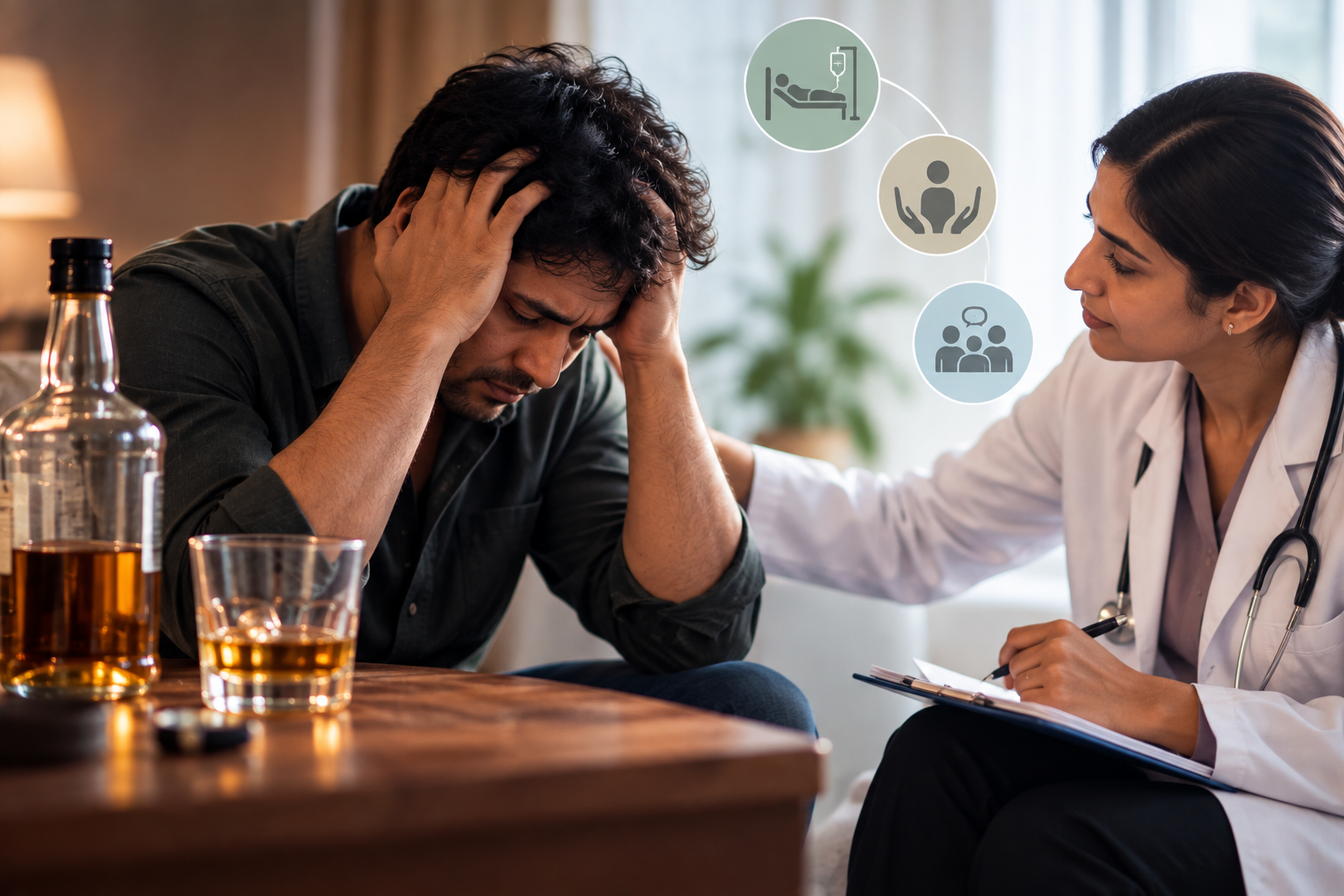
If you or someone you love drinks heavily every day, the idea of stopping can feel frightening, and for good reason. Many people worry about how bad it will feel. Fewer realise that, after long-term heavy drinking, stopping suddenly can be medically dangerous.
This guide explains what alcohol withdrawal is, what typically happens and when, who is at higher risk, and what medically supervised detox involves. It is general information, not medical advice. Anyone who is dependent on alcohol needs a doctor’s assessment before stopping.
In short
- Alcohol withdrawal is the body’s reaction when alcohol is stopped or sharply reduced after prolonged heavy use.
- It ranges from mild (shakiness, sweating, anxiety, poor sleep) to severe (seizures, hallucinations, confusion) and can be life-threatening.
- You can’t reliably predict who will develop severe withdrawal, but past complicated withdrawal, long-term daily drinking and other health conditions raise the risk.
- Medically supervised detox means assessment, monitoring and treatment so withdrawal is managed safely.
- Detox is only the first step. On its own it doesn’t treat the underlying alcohol use disorder.
What is alcohol withdrawal?
With regular heavy drinking, the brain adapts to alcohol’s calming, slowing effect. When alcohol is suddenly removed, the nervous system stays overactive, and that overactivity produces the symptoms of withdrawal.
Withdrawal is a sign of physical dependence. A person can be physically dependent without being able to say why they “need” a drink. They just know they feel awful without one. If you drink to stop shaking, sweating or anxiety, or to steady yourself in the morning, treat that as a warning sign. (If you’re unsure whether your drinking has become a disorder, see our guide to alcohol use disorder vs heavy drinking.)
Alcohol withdrawal symptoms
Common (mild to moderate) symptoms
- Tremor or shakiness in the hands
- Sweating
- Anxiety, restlessness or irritability
- Nausea or vomiting
- Headache
- Trouble sleeping
- Fast heartbeat and raised blood pressure
Serious (medical emergency) symptoms
- Seizures (fits)
- Seeing, hearing or feeling things that aren’t there
- Severe confusion or not knowing where you are
- High temperature
- Extreme agitation
Alcohol withdrawal timeline: what usually happens
Every person is different, and the times below are typical patterns, not promises.
| Time after the last drink | What can happen |
|---|---|
| About 6–12 hours | Tremor, sweating, anxiety, nausea, headache, difficulty sleeping |
| About 12–48 hours | Symptoms can intensify. This is the window when seizures are most likely, and some people have hallucinations |
| About 2–4 days | For a minority, delirium tremens (DTs): confusion, severe agitation, fever, very fast heartbeat, vivid hallucinations |
| From about day 4–5 | Symptoms usually ease in people who don’t develop complications, though poor sleep, low mood and anxiety can linger for weeks |
Delirium tremens is a medical emergency. It can be fatal without treatment, which is the main reason this article recommends supervision for anyone who is dependent on alcohol.
Why detoxing alone at home can be dangerous
The problem isn’t how uncomfortable withdrawal feels. It’s that severe withdrawal can develop quickly and unpredictably, and a person who is having a seizure or is confused cannot help themselves.
Unsupervised, common risks include:
- Seizures, with the risk of injury and choking
- Dangerous heart rhythm and blood-pressure changes
- Dehydration and low levels of important salts (electrolytes)
- Delirium tremens
- A serious brain condition linked to vitamin B1 deficiency (Wernicke’s encephalopathy), which is why doctors give vitamin B1 during detox
- Relapse driven by the discomfort, sometimes with a bigger drink than before
Please don’t take leftover tablets from another person or an old prescription to “help” you stop. Sedative medicines used in detox need a doctor’s dosing and monitoring, and taken alone they can be unsafe.
Who is at higher risk of severe withdrawal?
You can’t self-diagnose your own risk. A clinician assesses it. Factors that generally raise the risk include:
- Previous seizures or delirium tremens during withdrawal
- Long-term, heavy, daily drinking
- Several past episodes of stopping and restarting (some experts believe each episode can make the next one worse)
- Existing illness, particularly liver disease, infections or heart problems
- Poor nutrition or low salt levels
- Use of other sedatives or drugs alongside alcohol
- Older age
If any of these apply, medical supervision is especially important.
What does medically supervised detox involve?
A well-run detox is designed to keep you safe and as comfortable as possible.
- Assessment. A doctor reviews your drinking history, previous withdrawals, physical health, medicines and mental health, and usually arranges blood tests. Clinicians often use a rating scale such as the CIWA-Ar to measure withdrawal severity.
- Monitoring. Pulse, blood pressure, temperature and symptoms are checked regularly, so changes are caught early.
- Medication. Doctors commonly use medicines from the benzodiazepine group to calm the overactive nervous system and reduce seizure risk, adjusted to your symptoms. This must only be done under medical supervision.
- Nutrition and fluids. Vitamin B1 (thiamine), fluids and electrolyte correction help prevent complications.
- Care for other health and mental health needs. Sleep, anxiety, low mood and any physical conditions are addressed alongside withdrawal.
- A plan for what comes next. Detox handles the physical withdrawal. The recovery work comes afterwards.
How long does detox take? For many people the acute phase lasts about a week to ten days, sometimes longer if complications arise. Your doctor will guide you on timing.
Is inpatient detox always necessary?
No, and it’s worth being honest about that. Clinical guidelines such as those from NICE say that some people with mild dependence and good support at home can be treated as outpatients. Residential (inpatient) detox is usually recommended when:
- Dependence is moderate to severe
- There’s a history of seizures, delirium tremens or complicated withdrawal
- Other physical or mental health conditions need monitoring
- Home isn’t safe or supportive, or the person would be alone
- Earlier attempts at outpatient withdrawal haven’t worked
Only an assessment can answer this for you.
Detox is the first step, not the whole treatment
Alcohol use disorder is more than physical dependence. Detox clears alcohol from the body and manages withdrawal, but it doesn’t change the thoughts, habits, triggers or stress that led to heavy drinking. People who stop after detox alone often return to drinking.
Lasting recovery generally involves:
- Talking therapies (for example, cognitive behavioural therapy and motivational enhancement therapy)
- Treatment of any anxiety, depression, trauma or sleep problems
- Medication in some cases, prescribed by a doctor
- A structured relapse prevention programme and aftercare
- Family involvement and education
What to do in an emergency
Call 112 or go to the nearest emergency department straight away if someone who has stopped or cut down drinking:
- Has a seizure (fit)
- Sees, hears or feels things that aren’t there
- Is very confused or doesn’t know where they are
- Has a high temperature with severe shaking or agitation
- Has chest pain or a very fast, irregular heartbeat
- Can’t keep down fluids because of persistent vomiting
Don’t leave the person alone. While waiting, move hard objects away, place them on their side if they are unresponsive after a seizure, and don’t put anything in their mouth.
Questions to ask any detox facility
These help you compare places on safety, not on marketing:
- Who assesses me before admission, and what does the assessment include?
- Is a doctor available on site, and what happens in a medical emergency? Is there a hospital arrangement?
- How is withdrawal monitored, and how often?
- Which medicines are used, and who prescribes and supervises them?
- What happens after detox? Is there a plan for therapy and relapse prevention?
- Is my family involved, and how is confidentiality handled?
- Do you treat anxiety, depression or other conditions alongside alcohol use?
If a centre promises an easy, painless or guaranteed detox, or won’t answer these questions, be cautious.
How Thamarai can help
At Thamarai Healing Center in Pollachi, detoxification is medically supervised and begins with a comprehensive medical and physical assessment, including laboratory tests, followed by psychiatric, nutritional and lifestyle assessments. Our multidisciplinary team includes a consultant physician and a consultant psychiatrist, and detox leads into the rest of your care, from alcohol addiction treatment to relapse prevention. If a full residential programme isn’t right for you yet, our 30 Days Executive Detox Program is designed for people who can’t commit to a longer stay.
If you’re worried about withdrawal, a confidential conversation is a good first step. Speak to our team →
Frequently asked questions
How long does alcohol withdrawal last?
For most people, symptoms peak within the first two to three days and ease by around day four or five. Some people, particularly those with complications, take longer, and sleep and mood problems can persist for weeks.
Can I stop drinking at home?
For someone with mild dependence and good support, a doctor may plan a home-based withdrawal with regular check-ins. For anyone who is heavily or long-term dependent, stopping suddenly on your own is risky. Please speak to a doctor first.
What are delirium tremens (DTs)?
DTs are the most serious form of alcohol withdrawal, usually appearing two to four days after the last drink. Symptoms include confusion, hallucinations, fever, extreme agitation and a fast heartbeat. It is an emergency requiring hospital-level care.
What medicines are used in alcohol detox?
Doctors most commonly use benzodiazepine-group medicines to reduce withdrawal symptoms and seizure risk, along with vitamin B1 and fluids. Doses and choices depend on your health and are set by a doctor.
Is detox the same as rehab?
No. Detox manages the physical withdrawal. Rehab and follow-up treatment address the reasons for drinking and help you stay well.
How do I know whether I need inpatient detox?
A medical assessment decides. Factors include how much and how long you’ve been drinking, previous withdrawals, your health, and whether you have safe support at home.
This article is for general information and isn’t a substitute for professional medical advice, diagnosis or treatment.
Sources
- NICE. Alcohol-use disorders: diagnosis, assessment and management of harmful drinking (high-risk drinking) and alcohol dependence (CG115).
- NICE. Alcohol-use disorders: diagnosis and management of physical complications (CG100).
- The ASAM Clinical Practice Guideline on Alcohol Withdrawal Management. Journal of Addiction Medicine, 2020.
- Sullivan JT et al. Assessment of alcohol withdrawal: the revised Clinical Institute Withdrawal Assessment for Alcohol scale (CIWA-Ar). British Journal of Addiction, 1989.
- WHO. mhGAP Intervention Guide (module on disorders due to substance use).
- NIAAA. Treatment for Alcohol Problems: Finding and Getting Help.