
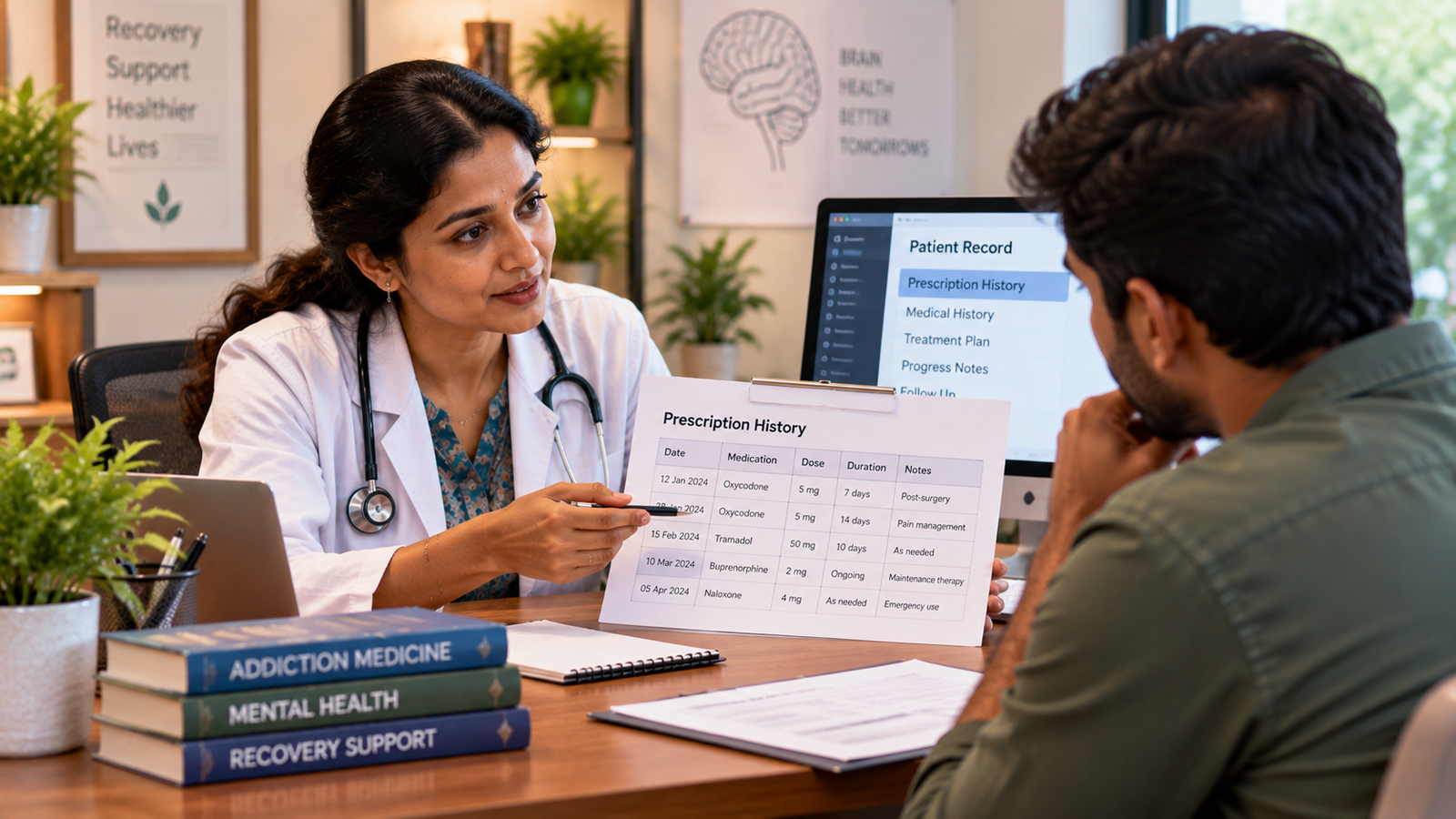
Prescription medicines are, by definition, prescribed by a doctor for a legitimate reason. That’s exactly what makes prescription drug addiction so easy to miss, in ourselves and in people we love. There’s no illicit purchase, no obvious red flag, just a medicine cabinet, a repeat prescription, and a pattern that can shift gradually from appropriate use into something harder to control.
This guide explains how prescription drug addiction develops, which medicines carry the most risk, the warning signs, and what to do if you’re concerned. It is general information, not medical advice. Never stop a prescribed medicine suddenly without talking to the prescribing doctor first. Some of these medicines carry real risks if stopped abruptly.
In short
- Three categories of prescription medicine carry the highest addiction risk: opioid painkillers, certain anti-anxiety and sedative medicines, and some sleep medicines.
- Dependence can develop even when a medicine is taken exactly as prescribed, which is different from addiction, though the two can overlap.
- Warning signs include running out early, taking more than prescribed, or feeling unable to function without the medicine.
- Stopping some of these medicines abruptly can be medically dangerous. Any change needs to be planned with a doctor.
- Effective treatment exists, and the starting point is always an honest conversation with a prescriber, not secrecy or self-management.
Why prescription drug addiction is different, and often harder to spot
With illicit drugs, there’s usually a clear line between “not using” and “using.” With prescription medicine, that line is blurrier. The person started taking it for a real reason, a doctor prescribed it, and the shift from appropriate use to a problem can happen gradually, sometimes without the person fully realising it themselves.
This is why prescription drug addiction often goes unrecognised longer than other forms. Families may assume “it’s just their medicine,” and the person themselves may genuinely believe they still need it for the original reason, even as the picture has changed.
The three main categories of risk
1. Opioid painkillers. Prescribed for moderate to severe pain, including after surgery, injury, or for ongoing pain conditions. These carry a well-documented risk of tolerance, dependence, and addiction, particularly with long-term or high-dose use. Our guide on opioid addiction and withdrawal covers this category specifically.
2. Benzodiazepines and related anti-anxiety or sedative medicines. Prescribed for anxiety, panic disorder, or short-term sleep problems, these medicines calm the nervous system. Clinical guidance, including from NICE, generally recommends they be used short-term, because tolerance and dependence can develop relatively quickly with regular use, and withdrawal from this category, after a period of regular use, can in some cases cause serious symptoms including seizures. This is a key difference from opioid withdrawal, which, while intensely uncomfortable, is rarely dangerous on its own.
3. Sleep medicines. Prescribed for insomnia, some sleep medicines, including some in a related chemical category to benzodiazepines, share a similar potential for tolerance and dependence with regular, long-term use, which is part of why doctors often recommend them only for short periods and alongside other approaches to improving sleep.
Across all three categories, the same underlying pattern applies: a medicine that is genuinely helpful for a real medical problem can, for some people, develop into dependence or addiction with continued use, particularly beyond the timeframe or dose a doctor intended.
Dependence vs addiction: an important distinction here
This distinction matters more for prescription medicines than almost anywhere else. As explained in our guide to addiction, dependence, and tolerance, it’s entirely possible to become physically dependent on a prescribed medicine, taken exactly as directed, without that meaning addiction is present. Physical dependence calls for a medically supervised, gradual reduction plan. Addiction, a compulsive pattern of use despite harm, calls for comprehensive treatment.
The two can also coexist. Someone can be both physically dependent on a prescribed medicine and have developed a pattern that meets the criteria for a substance use disorder. Only a clinical assessment can tell the difference, and this is precisely why self-diagnosis isn’t the way forward here. If you’re worried, the right step is a conversation with the prescribing doctor or another qualified clinician, not guesswork.
Warning signs of a developing problem
- Taking more of the medicine than prescribed, or more often
- Running out before the prescription should be due for renewal
- Seeking prescriptions from more than one doctor
- Feeling anxious or panicked at the thought of running out
- Using the medicine for reasons other than what it was prescribed for, such as to manage stress or to sleep when it wasn’t prescribed for that
- Continuing to use the medicine despite side effects or clear problems it’s causing
- Hiding use, or being defensive when asked about it
- Difficulty functioning, concentrating, or feeling “normal” without the medicine
As with other substance use patterns, a single sign in isolation isn’t necessarily cause for alarm. A cluster of these, especially over time, is worth raising with a doctor.
Why abrupt stopping can be dangerous
This bears repeating because it matters: for benzodiazepines, related sedatives, and some sleep medicines, stopping suddenly after a period of regular use can cause withdrawal symptoms that range from uncomfortable to medically serious, including, in some cases, seizures. This is a genuine medical risk, not an exaggeration, and it’s different from the pattern for some other substances.
If you or someone you know has been taking one of these medicines regularly and wants to stop, the message is simple: talk to the prescribing doctor first. A supervised, gradual reduction plan, sometimes called tapering, is the standard and safe approach. Never stop abruptly, and never follow advice from someone other than a qualified prescriber about how to come off these medicines.
What to do if you’re concerned about your own use
- Talk to the prescribing doctor honestly. This is the single most important step. Doctors are used to having these conversations and are there to help, not to judge.
- Don’t adjust your own dose, up or down, without medical guidance.
- If you’re getting prescriptions from multiple doctors, tell at least one of them the full picture. This isn’t about getting into trouble; it’s about getting accurate help.
- If stopping feels frightening or impossible, that itself is useful information to share with a doctor, since it may point toward dependence that needs a planned approach rather than willpower alone.
What to do if you’re concerned about a family member
- Approach the conversation with concern, not accusation. Describe specific things you’ve noticed rather than labelling them.
- Avoid confronting them when they might be under the influence of the medicine; choose a calmer moment.
- Offer to help them speak to their doctor, or to attend an appointment with them if that would help.
- Don’t take matters into your own hands, such as hiding or disposing of their medicine, without their knowledge and a medical plan, since this can push someone toward unsupervised and potentially dangerous withdrawal, or toward obtaining the substance elsewhere.
- Our guide on how to talk to a parent or spouse about getting help for addiction offers more detailed, practical language for this conversation.
Treatment for prescription drug addiction
Treatment generally involves:
- A full medical and psychiatric assessment, including an honest review of what’s being taken, how much, and why
- A medically supervised plan for the medicine itself, which may mean a carefully managed tapering schedule rather than abrupt stopping, particularly for benzodiazepines, related sedatives, or sleep medicines
- Medically supervised detoxification, where appropriate, especially if dependence is significant
- Behavioural therapies, such as cognitive behavioural therapy, to address the underlying patterns, triggers, and any issue, such as chronic pain, anxiety, or sleep problems, that the medicine was originally treating
- Treatment for the original problem, since stopping the medicine without addressing the underlying pain, anxiety, or sleep issue it was treating often sets someone up to struggle, which is why ongoing, legitimate care for that condition matters
- Ongoing support, since this, like other substance use disorders, benefits from long-term follow-up rather than a single intervention
How Thamarai can help
At Thamarai Healing Center in Pollachi, treatment for prescription drug addiction begins with a full medical and psychiatric assessment, so that any tapering or detoxification can be planned safely, and the original problem the medicine was treating, whether pain, anxiety, or sleep difficulties, is addressed as part of recovery, not left unmanaged. Our medically supervised detoxification and drug addiction treatment programmes are delivered under medical supervision by a multidisciplinary team.
If you or someone you love is concerned about dependence on a prescribed medicine, a confidential conversation is a safe place to start, and there’s no judgement involved. Speak to our team →
Frequently asked questions
Can I become addicted to medicine my doctor prescribed?
Yes, for some people, particularly with opioid painkillers, certain anti-anxiety or sedative medicines, and some sleep medicines, especially with longer-term or higher-dose use. This doesn’t mean anyone did anything wrong; it reflects how these medicines can affect the body and, for some people, the mind.
Is it dangerous to stop a prescribed medicine suddenly?
It can be, particularly for benzodiazepines, related sedatives, and some sleep medicines, where abrupt stopping after regular use can cause serious withdrawal symptoms, including seizures in some cases. Always talk to the prescribing doctor before making any change.
How is dependence different from addiction here?
Dependence means the body has adapted to the medicine and reacts with withdrawal if it’s stopped, which can happen even with correct, prescribed use. Addiction describes a broader pattern of compulsive use and loss of control. The two can occur separately or together, and only a clinical assessment can tell the difference.
What should I do if I think I’m becoming dependent on my medicine?
Talk to the prescribing doctor honestly and as soon as possible. They can assess the situation and plan a safe path forward, whether that’s a supervised tapering schedule or a different type of treatment.
My family member is taking prescribed medicine from multiple doctors. What should I do?
Approach them with concern rather than accusation, and offer to help them speak honestly to one of their doctors about the full picture. This is about getting them accurate medical help, not confrontation.
Will stopping the medicine bring back the original problem it was treating?
It might, if that problem, such as pain, anxiety, or insomnia, isn’t also actively treated. This is exactly why treatment plans need to address both the medicine dependence and the underlying condition together, not just stop the medicine in isolation.
This article is for general information and isn’t a substitute for professional medical advice, diagnosis or treatment. Never stop a prescribed medicine without first consulting the prescribing doctor.
Sources
- World Health Organization. Guidelines for the psychosocially assisted pharmacological treatment of opioid dependence and WHO guidance on rational use of medicines.
- National Institute on Drug Abuse (NIDA). Prescription Opioids DrugFacts and Misuse of Prescription Drugs Research Report.
- NICE. Generalised anxiety disorder and panic disorder in adults: management (CG113) and NICE guidance on benzodiazepine and z-drug prescribing.
- American Psychiatric Association. Diagnostic and Statistical Manual of Mental Disorders, Fifth Edition, Text Revision (DSM-5-TR). 2022.