
For many families, opioid addiction starts somewhere ordinary: a prescription after surgery, a painkiller for a back injury, a relative’s leftover tablets shared “just this once.” It rarely looks like what people picture when they hear the word “addiction,” which is part of why families are often blindsided by how serious it can become.
This guide explains what opioids are, how addiction develops, the warning signs, what withdrawal involves, and critically, how to recognise and respond to an overdose. It is general information, not medical advice. If you’re worried about a family member right now, please read the overdose section below regardless of anything else.
In short
- Opioids include prescription painkillers and illicit drugs like heroin. All carry a risk of dependence and addiction with regular use.
- Opioid withdrawal is intensely uncomfortable but, unlike alcohol withdrawal, is rarely life-threatening on its own. Opioid overdose is a life-threatening emergency.
- Warning signs include using more than prescribed, “doctor shopping,” mood and behaviour changes, and withdrawal symptoms between doses.
- Naloxone can reverse an opioid overdose in an emergency, and knowing the signs of overdose can save a life.
- Effective, evidence-based treatments exist, and families play an important role in recovery.
What are opioids?
Opioids are a class of substances that act on specific receptors in the brain and body to relieve pain. They include:
- Prescription painkillers, prescribed for moderate to severe pain, such as after surgery, injury, or for cancer-related pain
- Prescription cough suppressants containing opioid-based compounds
- Illicit opioids, such as heroin
All opioids, prescribed or illicit, carry a risk of tolerance, dependence, and addiction with regular use, which is why they are prescribed cautiously and monitored closely by doctors.
How opioid addiction develops
Opioid use disorder often begins with a legitimate medical need. According to the WHO and NIDA, common pathways include:
- Prescribed use that continues beyond what’s needed medically, sometimes because pain persists, sometimes because the person has developed dependence or is using the medicine to manage other distress.
- Using more than prescribed, or more often, to achieve the same pain relief as tolerance develops.
- Sharing or using someone else’s prescription.
- Moving to illicit opioids, sometimes because prescription medicine has become harder to obtain, or because it has become more expensive.
Not everyone prescribed an opioid develops an addiction, but certain factors raise the risk: a personal or family history of substance use disorders, mental health conditions such as depression or anxiety, a history of trauma, and long-term or high-dose prescribing.
Warning signs families can look for
These signs, taken together rather than in isolation, may indicate a developing problem:
- Using more medicine, or using it more often, than prescribed
- Running out of medicine early and requesting refills before due
- “Doctor shopping”, seeking prescriptions from multiple doctors
- Physical signs: drowsiness, constricted (very small) pupils, slurred speech, or nodding off unexpectedly
- Mood and behaviour changes: irritability, mood swings, or withdrawal from family and friends
- Financial problems that don’t add up, sometimes linked to spending on medicine
- Secrecy around medicine use, or medicine going missing from the household
- Continuing to use despite clear problems it’s causing at work, in relationships, or to health
If someone becomes defensive, evasive, or angry when asked about their medicine use, that reaction itself is often worth paying attention to.
Opioid withdrawal: what it looks like
Opioid withdrawal happens when someone who has developed physical dependence stops or significantly reduces use. Symptoms typically include:
- Anxiety and restlessness
- Muscle aches and pain
- Sweating and chills, sometimes with goosebumps
- Runny nose and watery eyes
- Nausea, vomiting, and diarrhoea
- Abdominal cramping
- Dilated pupils
- Rapid heartbeat and raised blood pressure
- Insomnia
- Intense cravings
An important distinction from alcohol withdrawal: opioid withdrawal is often described as feeling like a severe flu, and it can be extremely uncomfortable, but it is rarely life-threatening on its own in an otherwise healthy adult. This is different from alcohol or some sedative withdrawal, which can cause seizures and be fatal without medical supervision. That said, opioid withdrawal can still be dangerous in certain situations, including in people who are pregnant, have other serious health conditions, or become severely dehydrated from vomiting and diarrhoea, which is why medical guidance is still important.
The timeline varies depending on the specific opioid involved: withdrawal from shorter-acting opioids often begins within 8 to 24 hours of the last use and peaks within a few days, while withdrawal from longer-acting opioids can start later and last longer. A doctor can give a more specific picture based on what’s involved.
Why “just riding it out” isn’t the safest approach
Even though opioid withdrawal itself is rarely life-threatening, unsupervised withdrawal carries real risks:
- Severe discomfort often drives people back to using, sometimes at a dose their body can no longer tolerate safely after a period of abstinence, which raises overdose risk significantly (see below).
- Dehydration from vomiting and diarrhoea can become medically significant if untreated.
- The psychological experience of unsupervised withdrawal can be traumatic enough to discourage someone from trying to stop again.
Medically supervised approaches, including detoxification and, where appropriate, medically supervised treatment, are generally recommended over attempting withdrawal alone.
Opioid overdose: recognising the signs and responding
This is the most important section of this article. Opioid overdose is a medical emergency, and knowing the signs and how to respond can save a life.
Signs of opioid overdose:
- Extreme drowsiness, or being unable to wake the person
- Slow, shallow, or stopped breathing
- Choking or gurgling sounds
- Blue or grey lips, fingertips, or skin
- Pinpoint (very small) pupils
- Limp body
- Pale, clammy skin
What to do if you suspect an opioid overdose:
- Call for emergency medical help immediately. In India, call 112.
- Try to wake the person by calling their name and rubbing your knuckles firmly on their breastbone (sternum).
- If they’re not breathing normally or you can’t wake them, this is a life-threatening emergency. Stay with them and continue trying to get emergency help.
- If naloxone is available and you know how to use it, administer it. Naloxone is a medicine that can rapidly reverse the effects of an opioid overdose. It has been described by the WHO as a safe medicine with minimal risk when used to reverse a suspected opioid overdose, since it has essentially no effect if opioids aren’t present. Ask your doctor or treatment provider about naloxone access if opioid use is a concern in your family.
- Place the person in the recovery position (on their side) if they are breathing but unresponsive, to help prevent choking.
- Do not leave the person alone. Naloxone’s effects can wear off before the opioid’s effects do, meaning the person can stop breathing again even after appearing to recover, which is why emergency medical help is essential even if naloxone is given and seems to work.
Do not assume someone is “just sleeping it off.” If in doubt, treat it as an emergency and seek help. Acting quickly matters far more than being certain.
Talking to a family member about opioid use
If you suspect a problem, a calm, specific, and non-confrontational conversation tends to work better than confrontation or ultimatums delivered in anger. Focus on specific things you’ve observed rather than accusations, express concern rather than judgement, and be ready to offer to help them find professional support rather than trying to manage the situation alone. Our guide on how to talk to a parent or spouse about getting help for addiction has more detailed guidance that applies here too.
Treatment for opioid addiction
Effective, evidence-based treatment for opioid use disorder typically includes:
- A full medical and psychiatric assessment, to understand the pattern of use, physical health, and any co-occurring mental health conditions
- Medically supervised detoxification, where withdrawal is managed safely and as comfortably as possible
- Behavioural therapies, such as cognitive behavioural therapy, to address the underlying patterns and triggers
- Ongoing support and relapse prevention, since opioid use disorder, like other substance use disorders, is a chronic condition that benefits from long-term follow-up, not a one-time fix
- Family involvement, which research consistently links with better outcomes
Why families matter in recovery
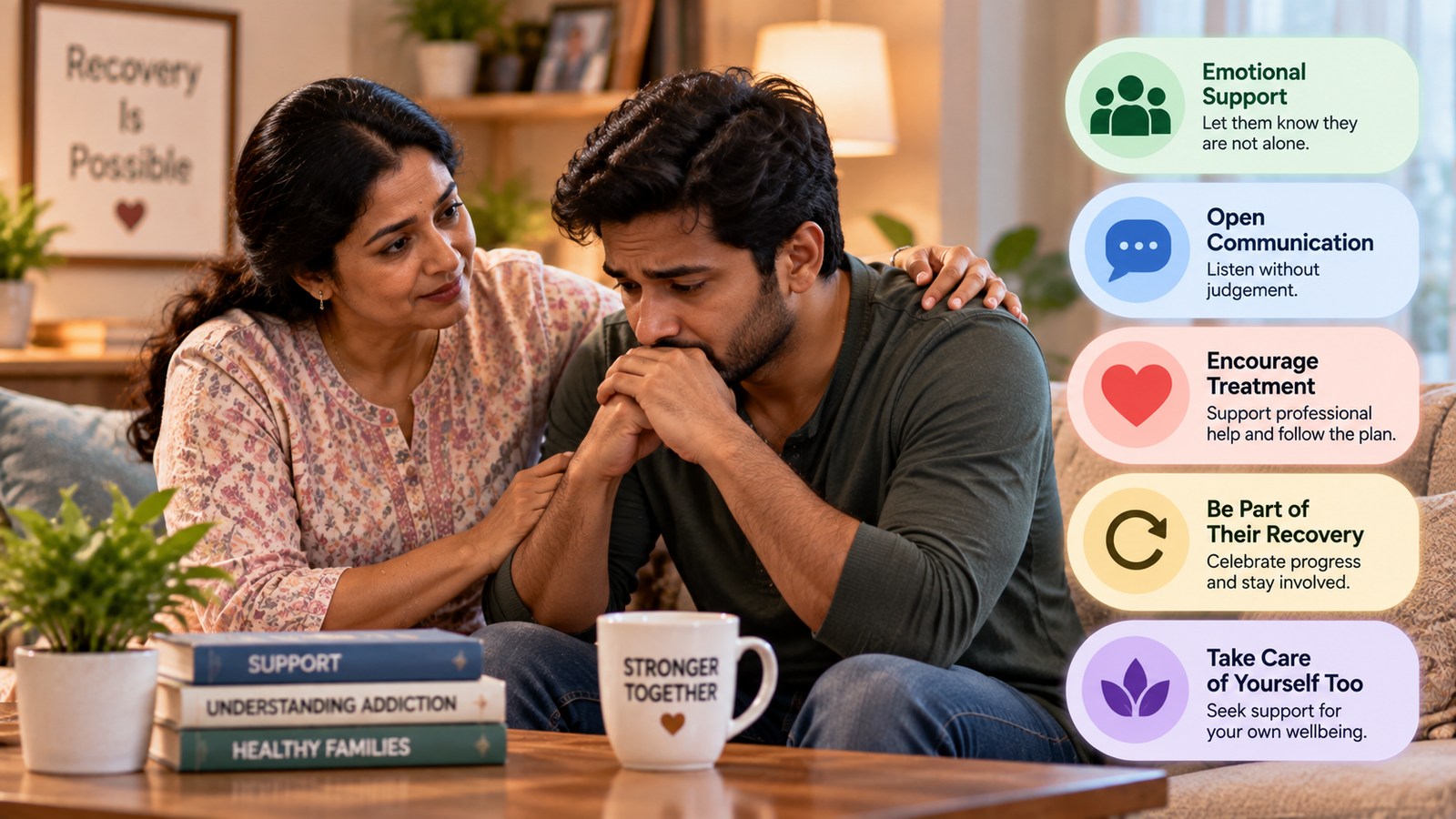
Family involvement isn’t just supportive in a general sense, it’s an active part of effective treatment. Families can help by learning about the condition, avoiding both enabling behaviours and shame-based confrontation, supporting treatment engagement, and taking care of their own wellbeing too, since supporting a loved one through addiction is genuinely difficult and families deserve support as well.
How Thamarai can help
At Thamarai Healing Center in Pollachi, treatment for opioid and other drug addiction begins with a comprehensive medical and psychiatric assessment, so that withdrawal is managed safely and the underlying pattern is properly understood. Our medically supervised detoxification and drug addiction treatment programmes are delivered by a multidisciplinary team, with family involvement built into the recovery process.
If you’re worried about a family member’s opioid use, please don’t wait. A confidential conversation is a good first step. Speak to our team →
Frequently asked questions
Is opioid withdrawal dangerous?
It’s rarely life-threatening on its own in an otherwise healthy adult, though it can be extremely uncomfortable. It can still be more risky in certain situations, including pregnancy, other serious health conditions, or severe dehydration, which is why medical guidance is recommended.
What’s the difference between opioid withdrawal and opioid overdose?
Withdrawal happens when opioid use stops and the body reacts to its absence, causing flu-like symptoms. Overdose happens when someone has taken more opioid than their body can safely process, causing dangerously slowed or stopped breathing. Overdose is a life-threatening emergency; withdrawal, while very uncomfortable, usually is not.
What should I do if I think someone has overdosed?
Call for emergency help immediately (112 in India), try to wake them, stay with them, and use naloxone if it’s available and you know how. Never assume someone is “just sleeping it off.”
Can someone become addicted to opioids even if a doctor prescribed them?
Yes. Prescribed use can lead to dependence and, in some people, addiction, particularly with long-term or high-dose use. This doesn’t mean the person did anything wrong; it reflects how these medicines affect the body.
Is naloxone something families should have at home?
If opioid use is a known concern in your family, ask a doctor or treatment provider about naloxone access and training. It’s described by health authorities as safe to use in a suspected overdose, with minimal risk even if opioids turn out not to be involved.
Does opioid addiction always start with prescription medicine?
No, but it’s a common pathway, alongside starting with illicit opioids directly. Both pathways carry real risk and deserve the same level of concern and response.
This article is for general information and isn’t a substitute for professional medical advice, diagnosis or treatment. If you suspect an overdose, seek emergency medical help immediately.
Sources
- World Health Organization. Information sheet on opioid overdose and Guidelines for the psychosocially assisted pharmacological treatment of opioid dependence.
- National Institute on Drug Abuse (NIDA). Opioid Overdose Crisis and Prescription Opioids DrugFacts.
- SAMHSA. Opioid Overdose Prevention Toolkit and TIP 63: Medications for Opioid Use Disorder.
- American Psychiatric Association. Diagnostic and Statistical Manual of Mental Disorders, Fifth Edition, Text Revision (DSM-5-TR). 2022.